

Introduction
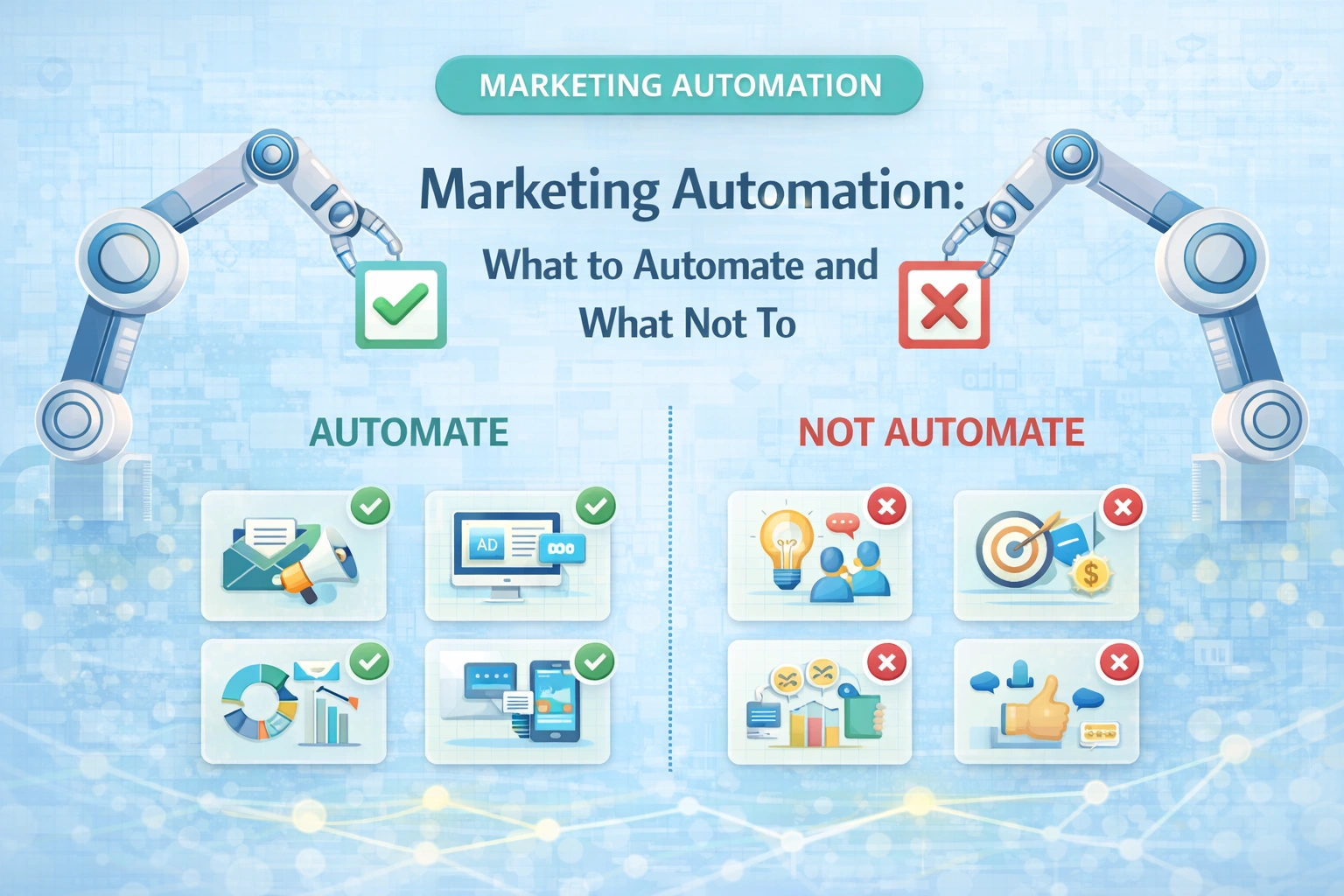
Marketing automation promises efficiency, scale, and consistency. In practice, it often delivers noise, user fatigue, and declining performance. The problem is not automation itself—it is what teams choose to automate. When automation replaces thinking instead of supporting it, funnels break faster and trust erodes silently.
This article explains what to automate and what not to automate in modern digital marketing, how to apply automation responsibly, and how mature teams use automation as infrastructure rather than a shortcut.
The Core Automation Mistake: Automating Before Understanding
Automation fails most often when it is implemented too early.
Common early-stage automation errors
- Automating generic email sequences
- Triggering messages without intent signals
- Scaling workflows before validation
- Optimizing tools instead of journeys
Automation should amplify clarity—not compensate for its absence.
What Automation Is Actually Good At
Automation excels at handling repeatable, rule-based tasks.
High-confidence automation strengths
- Consistent execution
- Timing precision
- Cross-channel coordination
- Operational efficiency
Automation struggles with nuance, judgment, and context.
What You Should Automate First
Successful automation starts with low-risk, high-impact areas.
1. Behavioral Triggers (Not Assumptions)
- Page visits
- Content depth consumed
- Repeat sessions
- CTA interactions
Behavioral triggers reflect real intent. Assumptions do not.
2. Lead Routing and Qualification
- Routing by intent level
- Routing by content category
- Routing by readiness signals
This reduces sales friction and improves response timing.
3. Nurture Timing and Cadence
- Delays between messages
- Cooldown periods after engagement
- Re-engagement after inactivity
Automation ensures pacing remains consistent and respectful.
4. Cross-Channel Reinforcement
- Email follow-ups after search visits
- Retargeting after content consumption
- Reminder messages after partial actions
This reinforces journeys users have already started.
What You Should Not Automate
Some decisions require human judgment.
1. Core Messaging Strategy
- Value proposition definition
- Problem framing
- Brand voice decisions
Automating messaging before it is proven creates inconsistency at scale.
2. Early-Stage Lead Conversion Pressure
- Immediate sales pushes
- Aggressive follow-ups
- One-size-fits-all offers
Premature automation erodes trust faster than manual outreach.
3. Complex Decision-Making
- High-value deal qualification
- Custom solution discussions
- Nuanced objections handling
Automation should support humans, not replace them.
Design Automation Around Intent, Not Volume
High-performing systems prioritize intent signals over activity counts.
| Signal Type | Automation Confidence |
|---|---|
| Repeated content engagement | High |
| Single page view | Low |
| Search intent keywords | High |
| Email opens alone | Low |
Automating weak signals creates false urgency.
Step 1: Validate Manually Before Automating
Before automating a workflow:
- Run it manually
- Observe user responses
- Identify friction points
- Refine messaging
Automation should scale what already works.
Step 2: Build Automation in Layers
Layered automation reduces risk.
Recommended layering approach
- Layer 1: Data capture and tagging
- Layer 2: Simple behavioral triggers
- Layer 3: Conditional branching
- Layer 4: Cross-channel orchestration
Skipping layers leads to fragile systems.
Step 3: Create Exit Conditions (This Is Critical)
Automation without exits causes fatigue.
Every workflow should include
- Conversion exits
- Inactivity pauses
- Negative signal suppression
- Manual override options
Respecting disengagement protects brand trust.
Step 4: Align Automation With Funnel Stages
Automation should support progression, not force it.
| Funnel Stage | Automation Role |
|---|---|
| Early | Education and reinforcement |
| Mid | Guidance and comparison |
| High | Enablement and coordination |
Misaligned automation creates resistance.
Step 5: Measure Automation Impact at the System Level
Automation success is not measured by volume.
Low-value automation metrics
- Emails sent
- Workflows created
- Trigger counts
High-value automation metrics
- Assisted conversions
- Time-to-decision reduction
- Lead quality improvement
- Sales efficiency gains
Automation should simplify growth, not complicate reporting.
Real-World Pattern: From Automation Overload to Controlled Scale
Before
- Dozens of workflows
- High unsubscribe rates
- Low conversion impact
Changes made
- Removed low-signal automations
- Rebuilt workflows around intent
- Introduced exit logic
After
- Fewer workflows
- Higher engagement
- Clear revenue contribution
Less automation produced better outcomes.
Why Automation Discipline Matters More in 2026
Modern environments increase automation risk:
- AI accelerates execution speed
- User tolerance for noise is lower
- Trust is harder to earn
- Decision journeys are non-linear
Uncontrolled automation fails faster than ever.
Final Takeaway
Automation is a force multiplier—good or bad.
High-performing digital marketing teams:
- Automate proven processes
- Prioritize intent over volume
- Design exits and safeguards
- Measure system impact
Automation should make marketing smarter, not louder.
