
Introduction
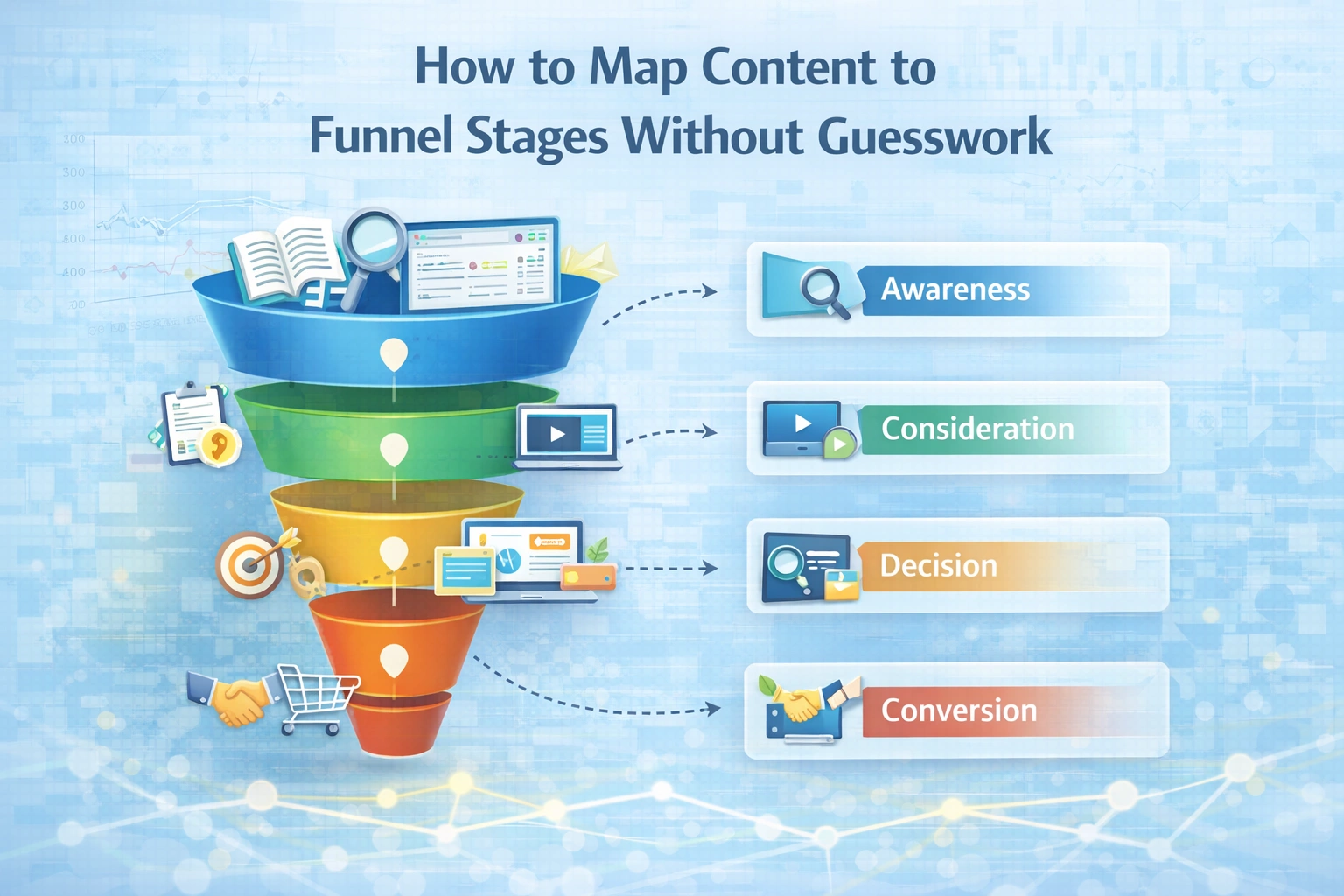
Most content-to-funnel mapping fails because it relies on assumptions instead of evidence. Teams label content as TOFU, MOFU, or BOFU based on intuition, then wonder why traffic doesn’t convert or why leads stall midway. In modern digital marketing, guessing where content belongs in the funnel creates friction, confuses users, and trains automation on weak signals.
This article explains how to map content to funnel stages without guesswork, using intent, behavior, and decision readiness to design content systems that move users forward naturally.
The Core Problem With Traditional Funnel Labels
TOFU, MOFU, and BOFU are convenient shortcuts, but they hide complexity.
Why these labels fail
- They assume linear behavior
- They ignore user context
- They treat all traffic equally
- They oversimplify intent
Users do not experience funnels as marketers describe them. They experience uncertainty, comparison, and risk.
Replace Funnel Stages With Intent Signals
Effective content mapping starts with understanding why a user is engaging, not where marketers think they are.
High-value intent signals include
- Search query language
- Content depth consumed
- Return frequency
- Navigation patterns
- CTA interactions
Intent signals provide real evidence of readiness.
Define Funnel Stages by User Mindset
Instead of abstract labels, define stages by mindset.
| User Mindset | Primary Question | Content Goal |
|---|---|---|
| Uncertain | “What’s happening?” | Clarify the problem |
| Problem-aware | “Is this my issue?” | Validate and explain |
| Evaluating | “What are my options?” | Compare approaches |
| Trust-building | “Who should I trust?” | Reduce risk |
| Action-ready | “What’s the next step?” | Enable commitment |
Content should answer the dominant question at each mindset stage.
Step 1: Analyze Entry Points, Not Just Content Topics
Where users enter determines how content should function.
Common entry points
- Organic search queries
- Paid search ads
- Email links
- Paid social retargeting
- Direct or branded visits
Entry context matters more than content format.
Step 2: Match Content Depth to Decision Readiness
Content fails when depth and readiness are misaligned.
Misalignment examples
- Long sales pages for early-stage users
- Surface-level blogs for high-intent visitors
- Generic CTAs for informed users
Depth should increase as uncertainty decreases.
Step 3: Design Content Paths, Not Isolated Assets
Single pieces of content rarely convert on their own.
Effective mapping includes
- Logical next-step links
- Stage-appropriate CTAs
- Contextual internal navigation
- Progressive information disclosure
Content should guide progression, not end the journey.
Step 4: Align CTAs With Funnel Readiness
| Readiness Level | CTA Type |
|---|---|
| Early | Learn more |
| Mid | See options |
| High | Take action |
When CTAs jump ahead of readiness, conversions stall.
Step 5: Use Behavioral Data to Validate Mapping
Guesswork disappears when behavior is observed.
Useful validation signals
- Scroll depth
- Time on page
- Return visits
- CTA interaction rates
- Assisted conversions
Behavior confirms whether content matches intent.
Step 6: Adjust Mapping as Intent Evolves
User intent is not static.
Content mapping should adapt to:
- Changing search behavior
- New competitors
- AI-influenced discovery
- Audience sophistication
Regular review prevents funnel decay.
Common Content-to-Funnel Mapping Mistakes
- Assigning stages based on content type alone
- Using one CTA everywhere
- Ignoring return visitors
- Measuring success by traffic only
These mistakes create friction instead of flow.
Real-World Pattern: From Guesswork to Systematic Mapping
Before
- High traffic, low progression
- Unclear content roles
- Generic CTAs
Changes made
- Mapped content by intent signals
- Redesigned CTAs by readiness
- Built guided content paths
After
- Higher assisted conversions
- Improved lead quality
- Shorter decision cycles
The improvement came from clarity, not volume.
Why Content Mapping Matters More in 2026
Modern discovery is compressed and competitive.
- AI answers reduce exploration time
- Users self-educate quickly
- Attention is fragmented
- Trust requires relevance
Content must meet users where they are, not where marketers hope they are.
Final Takeaway
Mapping content to funnel stages should never rely on guesswork.
High-performing teams:
- Use intent signals instead of labels
- Design content paths, not isolated pages
- Align CTAs with readiness
- Validate decisions with behavior
When content matches intent, progression feels natural—and conversion follows.
