Close Menu
blog.ykthakur.com

    Subscribe to Updates

    Get the latest creative news from FooBar about art, design and business.

    What's Hot

    Personal Branding Without the Cringe: Building Professional Credibility That Actually Works

    February 6, 2026

    Career Resilience: How to Build a Job That Survives Layoffs, AI, and Market Shifts

    February 6, 2026

    From Individual Contributor to Leader: The Career Shift Most People Get Wrong

    February 6, 2026
    Facebook X (Twitter) Instagram
    blog.ykthakur.com
    • Home
    • About Me
    • Case Studies
    • Services
    • Contact Us
    Facebook X (Twitter) Instagram
    Subscribe
    • Blog
    • Search & Growth
      1. SEO
      2. Technical SEO
      3. SEM
      4. Paid Advertisements
      5. View All

      Why SEO Fails Even With the Right Tools and Data

      January 31, 2026

      How to Refresh Old Content Without Losing Rankings

      January 31, 2026

      How to Build a Topic Authority Map for SEO

      January 31, 2026

      E-E-A-T Signals Explained: What Actually Influences Trust and Rankings

      January 31, 2026

      XML Sitemaps at Scale: Signaling Priority, Not Forcing Indexation

      February 3, 2026

      Robots.txt at Scale: Control, Risk, and the Limits of Crawl Directives

      February 3, 2026

      Monitoring, Alerting, and SEO Observability: Seeing Failures Before Traffic Drops

      February 3, 2026

      Migrations, Releases, and SEO Risk: How Technical Changes Break Search at Scale

      February 3, 2026

      Scaling SEM Without Burning Budget

      January 31, 2026

      SEM vs SEO: How Paid Search Should Support Organic Growth

      January 31, 2026

      Quality Score Demystified: What Actually Improves SEM Performance

      January 31, 2026

      Brand vs Non-Brand Search: Budget Allocation Reality

      January 31, 2026

      Personal Branding Without the Cringe: Building Professional Credibility That Actually Works

      February 6, 2026

      Career Resilience: How to Build a Job That Survives Layoffs, AI, and Market Shifts

      February 6, 2026

      From Individual Contributor to Leader: The Career Shift Most People Get Wrong

      February 6, 2026

      The Non-Linear Career: Why the Best Careers No Longer Follow a Straight Path

      February 6, 2026
    • Performance & Infrastructure
      1. Website Performance
      2. Core Web Vitals
      3. Hosting Architecture
      4. Web Application Infrastructure
      5. Load Balancing
      6. View All

      Performance Drift: How Sites Get Slower Without Any One Bad Change

      February 3, 2026

      Why passing scores still hide systemic performance risk

      February 3, 2026

      Performance Monitoring Beyond Core Web Vitals

      February 3, 2026

      Personal Branding Without the Cringe: Building Professional Credibility That Actually Works

      February 6, 2026

      Career Resilience: How to Build a Job That Survives Layoffs, AI, and Market Shifts

      February 6, 2026

      From Individual Contributor to Leader: The Career Shift Most People Get Wrong

      February 6, 2026

      The Non-Linear Career: Why the Best Careers No Longer Follow a Straight Path

      February 6, 2026
    • AI & Automation
      1. AI Content Systems
      2. AI in SEO & Marketing
      3. AI Search Analysis
      4. AI-Driven SEO Workflows
      5. Generative AI Strategy
      6. View All

      AI Content Systems: How to Scale Without Losing Quality or Trust

      February 3, 2026

      AI in Marketing Is a System, Not a Toolset

      February 3, 2026

      SEO in a Zero-Click World: Designing for AI Answers and Visibility

      February 3, 2026

      AI Search Analysis: How LLMs Interpret and Surface Content

      February 3, 2026

      Using AI for Technical SEO Analysis Without Breaking Trust

      February 3, 2026

      AI-Driven SEO Workflows: What to Automate and What Not To

      February 3, 2026

      SEO in a Zero-Click World: Designing for AI Answers and Visibility

      February 3, 2026

      AI Search Analysis: How LLMs Interpret and Surface Content

      February 3, 2026

      Using AI for Technical SEO Analysis Without Breaking Trust

      February 3, 2026

      AI-Driven SEO Workflows: What to Automate and What Not To

      February 3, 2026

      Why Most AI SEO Implementations Fail

      February 3, 2026

      Human-in-the-Loop SEO: Where AI Stops and Judgment Starts

      February 3, 2026

      Personal Branding Without the Cringe: Building Professional Credibility That Actually Works

      February 6, 2026

      Career Resilience: How to Build a Job That Survives Layoffs, AI, and Market Shifts

      February 6, 2026

      From Individual Contributor to Leader: The Career Shift Most People Get Wrong

      February 6, 2026

      The Non-Linear Career: Why the Best Careers No Longer Follow a Straight Path

      February 6, 2026
    • Analytics & Intelligence
      1. GA4 Architecture
      2. Adobe Analytics
      3. View All

      GA4 vs Adobe Analytics: Choosing the Right Tool for Your Organization

      February 2, 2026

      Consent, Privacy, and Measurement: What Changes After GDPR & GA4

      February 2, 2026

      GA4 Architecture Explained: Designing Events for Real Decisions

      February 2, 2026

      GA4 vs Adobe Analytics: Choosing the Right Tool for Your Organization

      February 2, 2026

      Personal Branding Without the Cringe: Building Professional Credibility That Actually Works

      February 6, 2026

      Career Resilience: How to Build a Job That Survives Layoffs, AI, and Market Shifts

      February 6, 2026

      From Individual Contributor to Leader: The Career Shift Most People Get Wrong

      February 6, 2026

      The Non-Linear Career: Why the Best Careers No Longer Follow a Straight Path

      February 6, 2026
    • WebOps & DevOps
      1. Web Operations
      2. WebOps Roles
      3. Website Migrations & Scaling
      4. Release Management
      5. Monitoring & Alerts
      6. Performance Monitoring
      7. Deployment Automation
      8. View All

      SEO and WebOps Monitoring: Aligning Health Signals Across Systems

      February 3, 2026

      Designing Alerts for WebOps: Signal, Severity, and Actionability

      February 3, 2026

      Why Most Website Monitoring Is Too Late to Be Useful

      February 3, 2026

      Release Cadence Versus Stability: Finding the Sustainable Balance

      February 3, 2026

      Website Migrations at Scale: Why Most Fail Before the First Redirect

      February 3, 2026

      Post-Migration Reality: Why SEO and Performance Losses Persist for Months

      February 3, 2026

      Scaling Websites Without Replatforming: When Migration Is the Wrong Answer

      February 3, 2026

      Release Cadence Versus Stability: Finding the Sustainable Balance

      February 3, 2026

      Why Website Releases Break SEO Even When Nothing “Major” Changes

      February 3, 2026

      Release Management for Websites: Coordinating Risk Across Teams

      February 3, 2026

      Release Pipelines and Search Risk: Why Velocity Without Guardrails Breaks Websites

      February 3, 2026

      SEO and WebOps Monitoring: Aligning Health Signals Across Systems

      February 3, 2026

      Designing Alerts for WebOps: Signal, Severity, and Actionability

      February 3, 2026

      Why Most Website Monitoring Is Too Late to Be Useful

      February 3, 2026

      Feature Flags, Experiments, and the SEO Blast Radius

      February 3, 2026

      Performance Drift: How Sites Get Slower Without Any One Bad Change

      February 3, 2026

      Performance Monitoring Beyond Core Web Vitals

      February 3, 2026

      Designing SEO-Safe Deployment Automation

      February 3, 2026

      Deployment Automation for Websites: What to Automate and What Not To

      February 3, 2026

      Personal Branding Without the Cringe: Building Professional Credibility That Actually Works

      February 6, 2026

      Career Resilience: How to Build a Job That Survives Layoffs, AI, and Market Shifts

      February 6, 2026

      From Individual Contributor to Leader: The Career Shift Most People Get Wrong

      February 6, 2026

      The Non-Linear Career: Why the Best Careers No Longer Follow a Straight Path

      February 6, 2026
    • Project Strategy

      Personal Branding Without the Cringe: Building Professional Credibility That Actually Works

      February 6, 2026

      Career Resilience: How to Build a Job That Survives Layoffs, AI, and Market Shifts

      February 6, 2026

      From Individual Contributor to Leader: The Career Shift Most People Get Wrong

      February 6, 2026

      The Non-Linear Career: Why the Best Careers No Longer Follow a Straight Path

      February 6, 2026

      How to Stay Relevant When Roles Are Changing Faster Than Job Descriptions

      February 6, 2026
    • Web Engineering
      1. Web Development
      2. Web Designing & UX
      3. CMS & Platforms
      4. Web Application Firewall
      5. View All

      Personal Branding Without the Cringe: Building Professional Credibility That Actually Works

      February 6, 2026

      Career Resilience: How to Build a Job That Survives Layoffs, AI, and Market Shifts

      February 6, 2026

      From Individual Contributor to Leader: The Career Shift Most People Get Wrong

      February 6, 2026

      The Non-Linear Career: Why the Best Careers No Longer Follow a Straight Path

      February 6, 2026
    blog.ykthakur.com
    Home»SEM»Strategy»SEM vs SEO: How Paid Search Should Support Organic Growth
    Strategy

    SEM vs SEO: How Paid Search Should Support Organic Growth

    yashwant160@gmail.comBy yashwant160@gmail.comJanuary 31, 2026Updated:February 1, 2026No Comments5 Mins Read
    Share Facebook Twitter Pinterest LinkedIn Tumblr Email
    Follow Us
    Google News Flipboard Threads
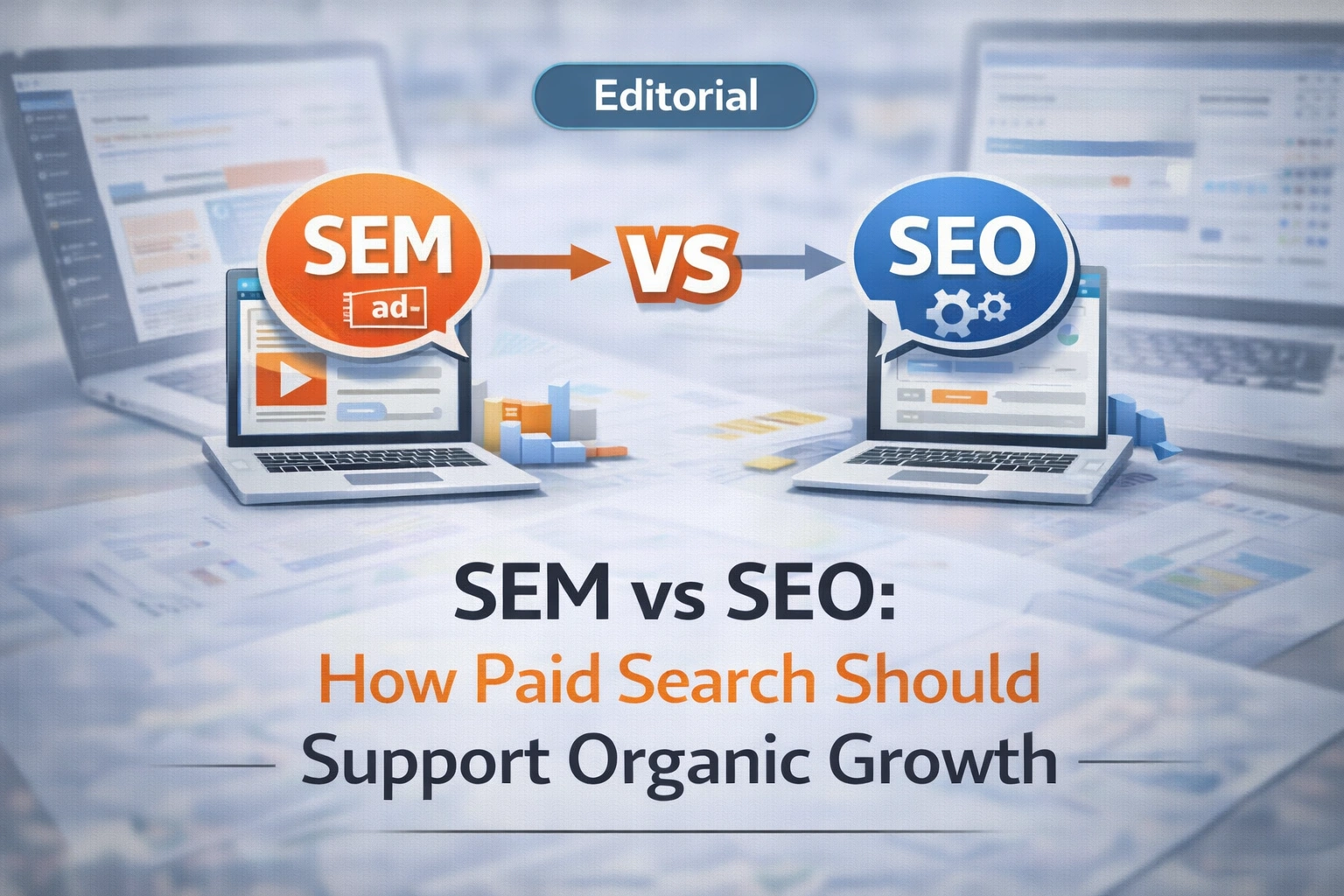
    SEM Vs SEO 1024x683
    Share
    Facebook Twitter LinkedIn Pinterest Email

    Introduction

    SEM and SEO are often treated as competing channels, forced to justify budgets against each other. This framing is fundamentally flawed. Paid search and organic search solve different problems at different stages of growth, and when they’re run in isolation, both underperform. Mature growth teams don’t ask whether SEO or SEM is better—they design systems where paid search accelerates organic learning and organic authority reduces paid dependency.

    This article explains how SEM should support SEO (not compete with it), when paid search fills critical gaps, and how to structure both channels to reinforce each other over time.

    The Core Difference Between SEM and SEO

    Understanding the role of each channel is essential.

    SEO is:

    • Authority-driven
    • Long-term
    • Compounding
    • Trust-based

    SEM is:

    • Intent-interception
    • Immediate
    • Budget-bound
    • Performance-driven

    SEO builds assets. SEM buys access.

    Confusing these roles leads to poor decisions.

    Why Treating SEM and SEO as Competitors Fails

    Common internal debates:

    • “SEM converts faster.”
    • “SEO is cheaper long-term.”
    • “Which one should get more budget?”

    This thinking leads to:

    • Channel silos
    • Redundant efforts
    • Missed learning opportunities
    • Slower growth

    The real question is:

    “How does each channel strengthen the other?”

    How SEM Supports SEO in Practice

    SEM plays three critical support roles for SEO.

    Role 1: SEM Validates Search Intent Faster Than SEO

    SEO intent discovery is slow.
    SEM intent validation is immediate.

    How this works

    • Launch ads for new keyword themes
    • Test messaging and offers
    • Measure CTR, conversion rate, and quality

    Within weeks, SEM reveals:

    • Which queries actually convert
    • Which intent framing resonates
    • Which keywords are misleading

    SEO can then prioritize proven intent, not guesses.

    Role 2: SEM Reveals SERP Reality SEO Tools Miss

    SEO tools show:

    • Volume estimates
    • Competition metrics
    • Keyword difficulty

    SEM shows:

    • Real auction behavior
    • CPC sensitivity
    • Competitive messaging
    • User response to offers

    Example

    A keyword looks strong in SEO tools—but:

    • CPC is extremely high
    • Ads show heavy competitor focus
    • Conversion quality is poor

    SEO teams can deprioritize content that looks attractive on paper but performs poorly in reality.

    Role 3: SEM Protects SEO During Authority Gaps

    SEO takes time to mature.

    SEM can:

    • Capture high-intent queries while SEO builds
    • Defend against competitor conquesting
    • Maintain visibility during algorithm volatility
    • Support launches, migrations, or content gaps

    SEM acts as a stability layer, not a replacement.

    How SEO Supports SEM in Return

    The relationship is not one-way.

    SEO strengthens SEM by:

    • Improving landing page quality
    • Increasing brand familiarity
    • Reducing CPC pressure
    • Improving Quality Score indirectly

    Strong organic presence lowers friction in paid campaigns.

    The Most Common SEM + SEO Integration Failure

    Teams often:

    • Share keywords but not insights
    • Compete for attribution credit
    • Optimize in isolation
    • Report separately

    This creates internal competition instead of compounding growth.

    Step-by-Step: Designing SEM to Support SEO

    Step 1: Separate Learning Campaigns From Revenue Campaigns

    Not all SEM spending should be judged on immediate ROI.

    Learning campaigns:

    • Test new keyword themes
    • Explore intent variations
    • Gather conversion insights

    Revenue campaigns:

    • Capture proven demand
    • Focus on efficiency
    • Scale cautiously

    SEO benefits most from learning-focused SEM.

    Step 2: Feed SEM Insights Into SEO Planning

    Use SEM data to inform:

    • Keyword prioritization
    • Content angle selection
    • Headline framing
    • CTA language

    If users won’t click or convert via SEM, they likely won’t via SEO either.

    Step 3: Use SEM to Test Content Before Scaling SEO

    Before committing to:

    • Long-form content
    • Pillar pages
    • Major clusters

    Run SEM tests to validate:

    • Topic relevance
    • Problem framing
    • Outcome appeal

    This reduces SEO risk and wasted effort.

    Step 4: Reduce Paid Spend as Organic Authority Builds

    As SEO improves:

    • Branded organic visibility increases
    • Non-brand rankings stabilize
    • CPC efficiency improves

    SEM budgets can:

    • Shift toward new opportunities
    • Reduce dependency on expensive keywords
    • Focus on incremental demand

    This transition must be intentional, not reactive.

    Step 5: Avoid Cannibalization Between SEM and SEO

    Common cannibalization patterns:

    • Paying for keywords you already dominate organically
    • Running ads that duplicate organic messaging
    • Measuring channels independently

    Fixes

    • Monitor overlap queries
    • Adjust bids based on organic position
    • Align messaging, not duplicate it

    Cannibalization is waste, not strategy.

    Real-World Integration Pattern

    Early stage

    • SEM drives most conversions
    • SEO builds a foundation
    • SEM insights guide content creation

    Growth stage

    • SEO begins capturing non-brand demand
    • SEM shifts toward high-intent gaps
    • Brand strength improves both channels

    Mature stage

    • SEO becomes the primary driver
    • SEM focuses on protection, testing, and expansion
    • Paid dependency decreases

    This is the ideal trajectory.

    How AI Search Changes SEM and SEO Integration

    AI-driven search:

    • Compresses informational queries
    • Elevates trusted sources
    • Reduces organic click opportunities for weak content

    SEM becomes more valuable for:

    • Testing
    • Protection
    • Differentiation

    SEO becomes more valuable for:

    • Authority
    • Trust
    • AI citation inclusion

    Integration becomes mandatory, not optional.

    Metrics That Matter for SEM + SEO Together

    Instead of channel-specific KPIs, track:

    • Assisted conversions
    • Brand search lift
    • Query overlap performance
    • Incremental cost per acquisition
    • Time-to-organic replacement

    These metrics reveal system-level health.

    Common Mistakes to Avoid

    • Letting channels compete internally
    • Cutting SEM when SEO improves (too early)
    • Scaling SEM without feeding SEO insights
    • Measuring success in silos

    Growth happens between channels, not within them.

    Final Takeaway

    SEM and SEO are not alternatives—they are accelerators for each other.

    SEM:

    • Tests
    • Protects
    • Stabilizes

    SEO:

    • Compounds
    • Builds trust
    • Reduces dependency

    The fastest-growing teams don’t choose between SEM and SEO.
    They design systems where each makes the other stronger.


    Share. Facebook Twitter Pinterest LinkedIn Tumblr Email
    yashwant160@gmail.com
    • Website

    Related Posts

    Scaling SEM Without Burning Budget

    January 31, 2026

    Why SEM Campaigns Fail Even With High Budgets

    January 31, 2026
    Leave A Reply Cancel Reply

    Don't Miss

    Personal Branding Without the Cringe: Building Professional Credibility That Actually Works

    yashwant160@gmail.comFebruary 6, 2026

    Personal branding has a reputation problem. Too often, it’s confused with self-promotion, performative posting, or…

    Career Resilience: How to Build a Job That Survives Layoffs, AI, and Market Shifts

    February 6, 2026

    From Individual Contributor to Leader: The Career Shift Most People Get Wrong

    February 6, 2026

    The Non-Linear Career: Why the Best Careers No Longer Follow a Straight Path

    February 6, 2026
    Stay In Touch
    • Facebook
    • Twitter
    • Pinterest
    • Instagram
    • YouTube
    • Vimeo

    Subscribe to Updates

    Get the latest creative news from SmartMag about art & design.

    About Us

    Results-driven digital professional with 15+ years of experience across Web Operations, Enterprise SEO, and large-scale digital platforms. I specialize in building, scaling, and optimizing complex websites where performance, search visibility, and operational reliability must work together—not in silos. My work sits at the intersection of strategy and execution, translating business goals into systems that teams can actually run.

    Facebook X (Twitter) Pinterest YouTube
    Our Picks

    Personal Branding Without the Cringe: Building Professional Credibility That Actually Works

    February 6, 2026

    Career Resilience: How to Build a Job That Survives Layoffs, AI, and Market Shifts

    February 6, 2026

    From Individual Contributor to Leader: The Career Shift Most People Get Wrong

    February 6, 2026
    Most Popular

    Top 15 popular link building methods you should consider before it’s too late

    March 24, 20180 Views

    Quality Score Demystified: What Actually Improves SEM Performance

    January 31, 20260 Views

    How SEO, SEM, Email, and Paid Social Should Work Together

    February 2, 20260 Views
    © 2026 All rights reserved. Y. K. Thakur.
    • Home
    • Technical SEO
    • World
    • Lifestyle
    • Buy Now

    Type above and press Enter to search. Press Esc to cancel.