Close Menu
blog.ykthakur.com

    Subscribe to Updates

    Get the latest creative news from FooBar about art, design and business.

    What's Hot

    Personal Branding Without the Cringe: Building Professional Credibility That Actually Works

    February 6, 2026

    Career Resilience: How to Build a Job That Survives Layoffs, AI, and Market Shifts

    February 6, 2026

    From Individual Contributor to Leader: The Career Shift Most People Get Wrong

    February 6, 2026
    Facebook X (Twitter) Instagram
    blog.ykthakur.com
    • Home
    • About Me
    • Case Studies
    • Services
    • Contact Us
    Facebook X (Twitter) Instagram
    Subscribe
    • Blog
    • Search & Growth
      1. SEO
      2. Technical SEO
      3. SEM
      4. Paid Advertisements
      5. View All

      Why SEO Fails Even With the Right Tools and Data

      January 31, 2026

      How to Refresh Old Content Without Losing Rankings

      January 31, 2026

      How to Build a Topic Authority Map for SEO

      January 31, 2026

      E-E-A-T Signals Explained: What Actually Influences Trust and Rankings

      January 31, 2026

      XML Sitemaps at Scale: Signaling Priority, Not Forcing Indexation

      February 3, 2026

      Robots.txt at Scale: Control, Risk, and the Limits of Crawl Directives

      February 3, 2026

      Monitoring, Alerting, and SEO Observability: Seeing Failures Before Traffic Drops

      February 3, 2026

      Migrations, Releases, and SEO Risk: How Technical Changes Break Search at Scale

      February 3, 2026

      Scaling SEM Without Burning Budget

      January 31, 2026

      SEM vs SEO: How Paid Search Should Support Organic Growth

      January 31, 2026

      Quality Score Demystified: What Actually Improves SEM Performance

      January 31, 2026

      Brand vs Non-Brand Search: Budget Allocation Reality

      January 31, 2026

      Personal Branding Without the Cringe: Building Professional Credibility That Actually Works

      February 6, 2026

      Career Resilience: How to Build a Job That Survives Layoffs, AI, and Market Shifts

      February 6, 2026

      From Individual Contributor to Leader: The Career Shift Most People Get Wrong

      February 6, 2026

      The Non-Linear Career: Why the Best Careers No Longer Follow a Straight Path

      February 6, 2026
    • Performance & Infrastructure
      1. Website Performance
      2. Core Web Vitals
      3. Hosting Architecture
      4. Web Application Infrastructure
      5. Load Balancing
      6. View All

      Performance Drift: How Sites Get Slower Without Any One Bad Change

      February 3, 2026

      Why passing scores still hide systemic performance risk

      February 3, 2026

      Performance Monitoring Beyond Core Web Vitals

      February 3, 2026

      Personal Branding Without the Cringe: Building Professional Credibility That Actually Works

      February 6, 2026

      Career Resilience: How to Build a Job That Survives Layoffs, AI, and Market Shifts

      February 6, 2026

      From Individual Contributor to Leader: The Career Shift Most People Get Wrong

      February 6, 2026

      The Non-Linear Career: Why the Best Careers No Longer Follow a Straight Path

      February 6, 2026
    • AI & Automation
      1. AI Content Systems
      2. AI in SEO & Marketing
      3. AI Search Analysis
      4. AI-Driven SEO Workflows
      5. Generative AI Strategy
      6. View All

      AI Content Systems: How to Scale Without Losing Quality or Trust

      February 3, 2026

      AI in Marketing Is a System, Not a Toolset

      February 3, 2026

      SEO in a Zero-Click World: Designing for AI Answers and Visibility

      February 3, 2026

      AI Search Analysis: How LLMs Interpret and Surface Content

      February 3, 2026

      Using AI for Technical SEO Analysis Without Breaking Trust

      February 3, 2026

      AI-Driven SEO Workflows: What to Automate and What Not To

      February 3, 2026

      SEO in a Zero-Click World: Designing for AI Answers and Visibility

      February 3, 2026

      AI Search Analysis: How LLMs Interpret and Surface Content

      February 3, 2026

      Using AI for Technical SEO Analysis Without Breaking Trust

      February 3, 2026

      AI-Driven SEO Workflows: What to Automate and What Not To

      February 3, 2026

      Why Most AI SEO Implementations Fail

      February 3, 2026

      Human-in-the-Loop SEO: Where AI Stops and Judgment Starts

      February 3, 2026

      Personal Branding Without the Cringe: Building Professional Credibility That Actually Works

      February 6, 2026

      Career Resilience: How to Build a Job That Survives Layoffs, AI, and Market Shifts

      February 6, 2026

      From Individual Contributor to Leader: The Career Shift Most People Get Wrong

      February 6, 2026

      The Non-Linear Career: Why the Best Careers No Longer Follow a Straight Path

      February 6, 2026
    • Analytics & Intelligence
      1. GA4 Architecture
      2. Adobe Analytics
      3. View All

      GA4 vs Adobe Analytics: Choosing the Right Tool for Your Organization

      February 2, 2026

      Consent, Privacy, and Measurement: What Changes After GDPR & GA4

      February 2, 2026

      GA4 Architecture Explained: Designing Events for Real Decisions

      February 2, 2026

      GA4 vs Adobe Analytics: Choosing the Right Tool for Your Organization

      February 2, 2026

      Personal Branding Without the Cringe: Building Professional Credibility That Actually Works

      February 6, 2026

      Career Resilience: How to Build a Job That Survives Layoffs, AI, and Market Shifts

      February 6, 2026

      From Individual Contributor to Leader: The Career Shift Most People Get Wrong

      February 6, 2026

      The Non-Linear Career: Why the Best Careers No Longer Follow a Straight Path

      February 6, 2026
    • WebOps & DevOps
      1. Web Operations
      2. WebOps Roles
      3. Website Migrations & Scaling
      4. Release Management
      5. Monitoring & Alerts
      6. Performance Monitoring
      7. Deployment Automation
      8. View All

      SEO and WebOps Monitoring: Aligning Health Signals Across Systems

      February 3, 2026

      Designing Alerts for WebOps: Signal, Severity, and Actionability

      February 3, 2026

      Why Most Website Monitoring Is Too Late to Be Useful

      February 3, 2026

      Release Cadence Versus Stability: Finding the Sustainable Balance

      February 3, 2026

      Website Migrations at Scale: Why Most Fail Before the First Redirect

      February 3, 2026

      Post-Migration Reality: Why SEO and Performance Losses Persist for Months

      February 3, 2026

      Scaling Websites Without Replatforming: When Migration Is the Wrong Answer

      February 3, 2026

      Release Cadence Versus Stability: Finding the Sustainable Balance

      February 3, 2026

      Why Website Releases Break SEO Even When Nothing “Major” Changes

      February 3, 2026

      Release Management for Websites: Coordinating Risk Across Teams

      February 3, 2026

      Release Pipelines and Search Risk: Why Velocity Without Guardrails Breaks Websites

      February 3, 2026

      SEO and WebOps Monitoring: Aligning Health Signals Across Systems

      February 3, 2026

      Designing Alerts for WebOps: Signal, Severity, and Actionability

      February 3, 2026

      Why Most Website Monitoring Is Too Late to Be Useful

      February 3, 2026

      Feature Flags, Experiments, and the SEO Blast Radius

      February 3, 2026

      Performance Drift: How Sites Get Slower Without Any One Bad Change

      February 3, 2026

      Performance Monitoring Beyond Core Web Vitals

      February 3, 2026

      Designing SEO-Safe Deployment Automation

      February 3, 2026

      Deployment Automation for Websites: What to Automate and What Not To

      February 3, 2026

      Personal Branding Without the Cringe: Building Professional Credibility That Actually Works

      February 6, 2026

      Career Resilience: How to Build a Job That Survives Layoffs, AI, and Market Shifts

      February 6, 2026

      From Individual Contributor to Leader: The Career Shift Most People Get Wrong

      February 6, 2026

      The Non-Linear Career: Why the Best Careers No Longer Follow a Straight Path

      February 6, 2026
    • Project Strategy

      Personal Branding Without the Cringe: Building Professional Credibility That Actually Works

      February 6, 2026

      Career Resilience: How to Build a Job That Survives Layoffs, AI, and Market Shifts

      February 6, 2026

      From Individual Contributor to Leader: The Career Shift Most People Get Wrong

      February 6, 2026

      The Non-Linear Career: Why the Best Careers No Longer Follow a Straight Path

      February 6, 2026

      How to Stay Relevant When Roles Are Changing Faster Than Job Descriptions

      February 6, 2026
    • Web Engineering
      1. Web Development
      2. Web Designing & UX
      3. CMS & Platforms
      4. Web Application Firewall
      5. View All

      Personal Branding Without the Cringe: Building Professional Credibility That Actually Works

      February 6, 2026

      Career Resilience: How to Build a Job That Survives Layoffs, AI, and Market Shifts

      February 6, 2026

      From Individual Contributor to Leader: The Career Shift Most People Get Wrong

      February 6, 2026

      The Non-Linear Career: Why the Best Careers No Longer Follow a Straight Path

      February 6, 2026
    blog.ykthakur.com
    Home»SEM»Ad Copy Optimization»Quality Score Demystified: What Actually Improves SEM Performance
    Ad Copy Optimization

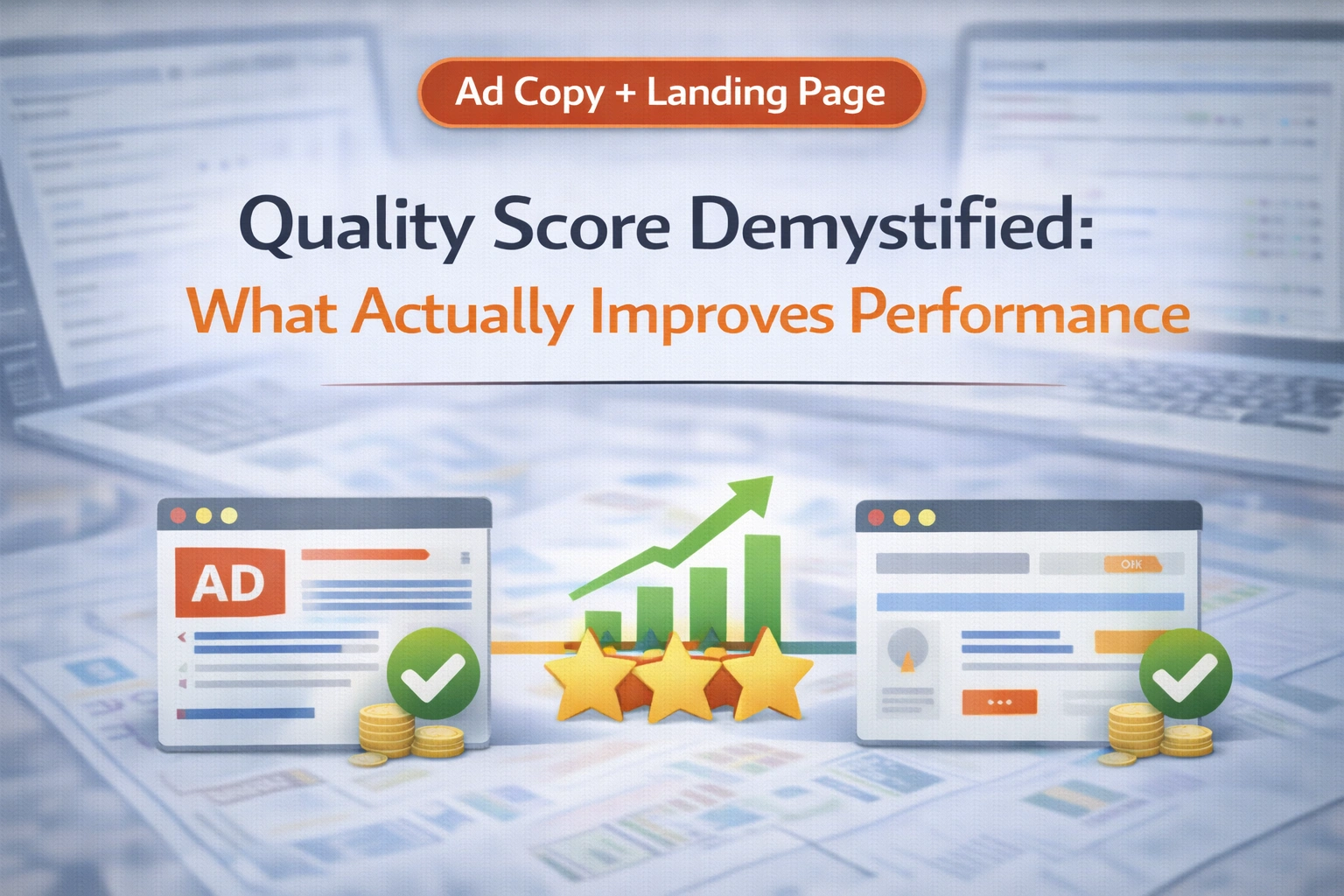
    Quality Score Demystified: What Actually Improves SEM Performance

    yashwant160@gmail.comBy yashwant160@gmail.comJanuary 31, 2026Updated:February 1, 2026No Comments5 Mins Read
    Share Facebook Twitter Pinterest LinkedIn Tumblr Email
    Follow Us
    Google News Flipboard Threads
    Quality Score 1024x683
    Share
    Facebook Twitter LinkedIn Pinterest Email

    Introduction

    Quality Score is one of the most misunderstood elements in paid search. Many teams obsess over improving the number itself without understanding what it represents—or how it actually affects performance. Quality Score is not a lever you pull; it’s a diagnostic reflection of how well your campaigns align with user intent. When teams chase the metric instead of the system behind it, optimization efforts often miss the mark.

    This article explains what Quality Score really measures, why improving it indirectly matters, and what actually improves SEM performance in practice.

    What Quality Score Is (And What It Isn’t)

    Quality Score is:

    • A relative signal
    • A feedback mechanism
    • A proxy for relevance

    Quality Score is not:

    • A direct ranking factor
    • A goal in itself
    • A fixed performance metric

    It reflects how well:

    • Keywords
    • Ads
    • Landing pages

    …work together to satisfy search intent.

    Why Quality Score Matters Indirectly

    While Quality Score itself isn’t optimized directly, it influences:

    • Ad eligibility
    • CPC efficiency
    • Auction competitiveness
    • Impression potential

    Higher Quality Scores:

    • Reduce the cost to win auctions
    • Stabilize CPCs
    • Improve reach without increasing bids

    Lower Quality Scores force advertisers to pay more for the same visibility.

    The Three Core Components of Quality Score

    Quality Score is driven by three primary dimensions.

    1. Expected Click-Through Rate (CTR)

    Expected CTR reflects:

    • How likely users are to click your ad
    • Relative to competitors for the same query

    It is influenced by:

    • Ad relevance
    • Historical performance
    • Intent alignment

    CTR is not about volume—it’s about fit.

    1. Ad Relevance

    Ad relevance measures:

    • How closely ad copy match the keyword intent
    • How well the message answers the search query

    Relevance drops when:

    • Ads are reused across intents
    • Messaging is generic
    • Keywords are overly broad

    Strong relevance requires tight keyword-to-ad mapping.

    1. Landing Page Experience

    Landing page experience evaluates:

    • Relevance
    • Usability
    • Load performance
    • Content clarity

    It reflects whether:

    • The page fulfills the ad promise
    • Users can take action easily
    • The experience matches expectations

    Landing pages are often the weakest link.

    Why Chasing Quality Score Alone Fails

    Many teams try to “fix” Quality Score by:

    • Stuffing keywords into ads
    • Writing awkward copy
    • Making cosmetic landing page changes

    These tactics:

    • Hurt user experience
    • Lower conversion quality
    • Increase bounce rates
    • Undermine long-term performance

    Quality Score improves as a result of better systems—not tricks.

    Step 1: Improve Intent Alignment First

    Intent misalignment is the root cause of low Quality Scores.

    Example misalignment

    • Keyword: “SEO audit checklist.”
    • Ad: “Hire Our SEO Experts.”
    • Landing Page: Sales pitch

    Even if each component is strong, together they fail.

    Fix

    • Match educational intent with educational content
    • Reserve sales pages for transactional queries

    Intent alignment improves all three Quality Score components simultaneously.

    Step 2: Tighten Keyword Grouping (Without Over-Segmentation)

    Overly broad ad groups dilute relevance.
    Overly granular ones create management overhead.

    Effective grouping principles

    • Group by problem or intent
    • Avoid mixing question-based and transactional keywords
    • Separate branded, competitor, and generic queries

    Better grouping leads to:

    • Clearer ad messaging
    • Higher CTR
    • Improved relevance signals

    Step 3: Write Ads That Pre-Qualify Clicks

    Quality Score improves when:

    • The right users click
    • The wrong users don’t

    Example

    Generic ad

    “Expert SEO Services – Get Started Today”

    Intent-aligned ad

    “SEO Audit for Sites Losing Traffic – Fix Issues Fast”

    The second ad:

    • Reduces irrelevant clicks
    • Improves CTR quality
    • Supports better landing page alignment

    Step 4: Fix Landing Page Experience Holistically

    Landing page experience is not about:

    • Design trends
    • Long-form content
    • Visual polish alone

    It’s about:

    • Relevance
    • Clarity
    • Speed
    • Usability

    High-impact improvements

    • Headline mirrors ad promise
    • Clear CTA
    • Minimal distractions
    • Fast mobile load
    • Logical content flow

    Small changes here often produce outsized gains.

    Step 5: Reduce Bounce Rate by Meeting Expectations

    High bounce rate often signals:

    • Mismatched intent
    • Confusing messaging
    • Slow load times

    Bounce rate alone isn’t a Quality Score metric—but it correlates strongly with poor landing page experience.

    Reducing bounce improves:

    • Engagement signals
    • Conversion rates
    • Downstream performance

    Step 6: Improve Account History Through Consistency

    Quality Score is influenced by:

    • Historical performance
    • Account-wide behavior
    • Pattern recognition over time

    Frequent disruptive changes:

    • Reset learning
    • Increase volatility
    • Delay improvement

    Consistency allows Quality Score gains to compound.

    Step 7: Prioritize High-Impact Fixes Over Cosmetic Tweaks

    High-impact actions:

    • Intent-based restructuring
    • Dedicated landing pages
    • Clear messaging

    Low-impact distractions:

    • Minor wording tweaks
    • Keyword stuffing
    • Excessive A/B testing without hypotheses

    Focus on system-level improvements.

    Real-World Pattern: Quality Score Improves After Structural Fixes

    Before

    • Average Quality Score: 5–6
    • Rising CPCs
    • Inconsistent performance

    Changes made

    • Separated intent-based campaigns
    • Aligned ads and landing pages
    • Reduced broad match usage

    After (8–12 weeks)

    • Quality Scores stabilized at 7–8
    • CPCs decreased
    • Conversion rates improved
    • Spend efficiency increased

    Quality Score improved because the system improved.

    Quality Score and Automation: The Feedback Loop

    Automation relies on:

    • Clean signals
    • Predictable outcomes

    Higher Quality Scores:

    • Improve auction competitiveness
    • Reduce reliance on aggressive bidding
    • Stabilize automated strategies

    Poor Quality Scores force automation to overbid to compensate.

    Why Quality Score Is a Lagging Indicator

    Quality Score reflects:

    • Past performance
    • Learned behavior
    • Accumulated signals

    It should be used to:

    • Diagnose issues
    • Validate improvements
    • Guide structural decisions

    Not to drive daily optimization.

    Common Myths About Quality Score

    • “We need a 10/10 score” → No
    • “Quality Score is everything” → No
    • “We can fix it with better ads alone.” → No

    Quality Score follows alignment—not effort.

    Final Takeaway

    Quality Score is not a metric to chase—it’s a mirror.

    It reflects:

    • Intent alignment
    • Structural discipline
    • Landing page relevance
    • Consistent execution

    Improve the system, and the Quality Score follows.
    Chase the score, and performance stalls.


    Share. Facebook Twitter Pinterest LinkedIn Tumblr Email
    yashwant160@gmail.com
    • Website

    Related Posts

    Ad Copy Optimization: Writing Ads That Match Search Intent

    January 31, 2026
    Leave A Reply Cancel Reply

    Don't Miss

    Personal Branding Without the Cringe: Building Professional Credibility That Actually Works

    yashwant160@gmail.comFebruary 6, 2026

    Personal branding has a reputation problem. Too often, it’s confused with self-promotion, performative posting, or…

    Career Resilience: How to Build a Job That Survives Layoffs, AI, and Market Shifts

    February 6, 2026

    From Individual Contributor to Leader: The Career Shift Most People Get Wrong

    February 6, 2026

    The Non-Linear Career: Why the Best Careers No Longer Follow a Straight Path

    February 6, 2026
    Stay In Touch
    • Facebook
    • Twitter
    • Pinterest
    • Instagram
    • YouTube
    • Vimeo

    Subscribe to Updates

    Get the latest creative news from SmartMag about art & design.

    About Us

    Results-driven digital professional with 15+ years of experience across Web Operations, Enterprise SEO, and large-scale digital platforms. I specialize in building, scaling, and optimizing complex websites where performance, search visibility, and operational reliability must work together—not in silos. My work sits at the intersection of strategy and execution, translating business goals into systems that teams can actually run.

    Facebook X (Twitter) Pinterest YouTube
    Our Picks

    Personal Branding Without the Cringe: Building Professional Credibility That Actually Works

    February 6, 2026

    Career Resilience: How to Build a Job That Survives Layoffs, AI, and Market Shifts

    February 6, 2026

    From Individual Contributor to Leader: The Career Shift Most People Get Wrong

    February 6, 2026
    Most Popular

    Top 15 popular link building methods you should consider before it’s too late

    March 24, 20180 Views

    Quality Score Demystified: What Actually Improves SEM Performance

    January 31, 20260 Views

    How SEO, SEM, Email, and Paid Social Should Work Together

    February 2, 20260 Views
    © 2026 All rights reserved. Y. K. Thakur.
    • Home
    • Technical SEO
    • World
    • Lifestyle
    • Buy Now

    Type above and press Enter to search. Press Esc to cancel.