Close Menu
blog.ykthakur.com

    Subscribe to Updates

    Get the latest creative news from FooBar about art, design and business.

    What's Hot

    Personal Branding Without the Cringe: Building Professional Credibility That Actually Works

    February 6, 2026

    Career Resilience: How to Build a Job That Survives Layoffs, AI, and Market Shifts

    February 6, 2026

    From Individual Contributor to Leader: The Career Shift Most People Get Wrong

    February 6, 2026
    Facebook X (Twitter) Instagram
    blog.ykthakur.com
    • Home
    • About Me
    • Case Studies
    • Services
    • Contact Us
    Facebook X (Twitter) Instagram
    Subscribe
    • Blog
    • Search & Growth
      1. SEO
      2. Technical SEO
      3. SEM
      4. Paid Advertisements
      5. View All

      Why SEO Fails Even With the Right Tools and Data

      January 31, 2026

      How to Refresh Old Content Without Losing Rankings

      January 31, 2026

      How to Build a Topic Authority Map for SEO

      January 31, 2026

      E-E-A-T Signals Explained: What Actually Influences Trust and Rankings

      January 31, 2026

      XML Sitemaps at Scale: Signaling Priority, Not Forcing Indexation

      February 3, 2026

      Robots.txt at Scale: Control, Risk, and the Limits of Crawl Directives

      February 3, 2026

      Monitoring, Alerting, and SEO Observability: Seeing Failures Before Traffic Drops

      February 3, 2026

      Migrations, Releases, and SEO Risk: How Technical Changes Break Search at Scale

      February 3, 2026

      Scaling SEM Without Burning Budget

      January 31, 2026

      SEM vs SEO: How Paid Search Should Support Organic Growth

      January 31, 2026

      Quality Score Demystified: What Actually Improves SEM Performance

      January 31, 2026

      Brand vs Non-Brand Search: Budget Allocation Reality

      January 31, 2026

      Personal Branding Without the Cringe: Building Professional Credibility That Actually Works

      February 6, 2026

      Career Resilience: How to Build a Job That Survives Layoffs, AI, and Market Shifts

      February 6, 2026

      From Individual Contributor to Leader: The Career Shift Most People Get Wrong

      February 6, 2026

      The Non-Linear Career: Why the Best Careers No Longer Follow a Straight Path

      February 6, 2026
    • Performance & Infrastructure
      1. Website Performance
      2. Core Web Vitals
      3. Hosting Architecture
      4. Web Application Infrastructure
      5. Load Balancing
      6. View All

      Performance Drift: How Sites Get Slower Without Any One Bad Change

      February 3, 2026

      Why passing scores still hide systemic performance risk

      February 3, 2026

      Performance Monitoring Beyond Core Web Vitals

      February 3, 2026

      Personal Branding Without the Cringe: Building Professional Credibility That Actually Works

      February 6, 2026

      Career Resilience: How to Build a Job That Survives Layoffs, AI, and Market Shifts

      February 6, 2026

      From Individual Contributor to Leader: The Career Shift Most People Get Wrong

      February 6, 2026

      The Non-Linear Career: Why the Best Careers No Longer Follow a Straight Path

      February 6, 2026
    • AI & Automation
      1. AI Content Systems
      2. AI in SEO & Marketing
      3. AI Search Analysis
      4. AI-Driven SEO Workflows
      5. Generative AI Strategy
      6. View All

      AI Content Systems: How to Scale Without Losing Quality or Trust

      February 3, 2026

      AI in Marketing Is a System, Not a Toolset

      February 3, 2026

      SEO in a Zero-Click World: Designing for AI Answers and Visibility

      February 3, 2026

      AI Search Analysis: How LLMs Interpret and Surface Content

      February 3, 2026

      Using AI for Technical SEO Analysis Without Breaking Trust

      February 3, 2026

      AI-Driven SEO Workflows: What to Automate and What Not To

      February 3, 2026

      SEO in a Zero-Click World: Designing for AI Answers and Visibility

      February 3, 2026

      AI Search Analysis: How LLMs Interpret and Surface Content

      February 3, 2026

      Using AI for Technical SEO Analysis Without Breaking Trust

      February 3, 2026

      AI-Driven SEO Workflows: What to Automate and What Not To

      February 3, 2026

      Why Most AI SEO Implementations Fail

      February 3, 2026

      Human-in-the-Loop SEO: Where AI Stops and Judgment Starts

      February 3, 2026

      Personal Branding Without the Cringe: Building Professional Credibility That Actually Works

      February 6, 2026

      Career Resilience: How to Build a Job That Survives Layoffs, AI, and Market Shifts

      February 6, 2026

      From Individual Contributor to Leader: The Career Shift Most People Get Wrong

      February 6, 2026

      The Non-Linear Career: Why the Best Careers No Longer Follow a Straight Path

      February 6, 2026
    • Analytics & Intelligence
      1. GA4 Architecture
      2. Adobe Analytics
      3. View All

      GA4 vs Adobe Analytics: Choosing the Right Tool for Your Organization

      February 2, 2026

      Consent, Privacy, and Measurement: What Changes After GDPR & GA4

      February 2, 2026

      GA4 Architecture Explained: Designing Events for Real Decisions

      February 2, 2026

      GA4 vs Adobe Analytics: Choosing the Right Tool for Your Organization

      February 2, 2026

      Personal Branding Without the Cringe: Building Professional Credibility That Actually Works

      February 6, 2026

      Career Resilience: How to Build a Job That Survives Layoffs, AI, and Market Shifts

      February 6, 2026

      From Individual Contributor to Leader: The Career Shift Most People Get Wrong

      February 6, 2026

      The Non-Linear Career: Why the Best Careers No Longer Follow a Straight Path

      February 6, 2026
    • WebOps & DevOps
      1. Web Operations
      2. WebOps Roles
      3. Website Migrations & Scaling
      4. Release Management
      5. Monitoring & Alerts
      6. Performance Monitoring
      7. Deployment Automation
      8. View All

      SEO and WebOps Monitoring: Aligning Health Signals Across Systems

      February 3, 2026

      Designing Alerts for WebOps: Signal, Severity, and Actionability

      February 3, 2026

      Why Most Website Monitoring Is Too Late to Be Useful

      February 3, 2026

      Release Cadence Versus Stability: Finding the Sustainable Balance

      February 3, 2026

      Website Migrations at Scale: Why Most Fail Before the First Redirect

      February 3, 2026

      Post-Migration Reality: Why SEO and Performance Losses Persist for Months

      February 3, 2026

      Scaling Websites Without Replatforming: When Migration Is the Wrong Answer

      February 3, 2026

      Release Cadence Versus Stability: Finding the Sustainable Balance

      February 3, 2026

      Why Website Releases Break SEO Even When Nothing “Major” Changes

      February 3, 2026

      Release Management for Websites: Coordinating Risk Across Teams

      February 3, 2026

      Release Pipelines and Search Risk: Why Velocity Without Guardrails Breaks Websites

      February 3, 2026

      SEO and WebOps Monitoring: Aligning Health Signals Across Systems

      February 3, 2026

      Designing Alerts for WebOps: Signal, Severity, and Actionability

      February 3, 2026

      Why Most Website Monitoring Is Too Late to Be Useful

      February 3, 2026

      Feature Flags, Experiments, and the SEO Blast Radius

      February 3, 2026

      Performance Drift: How Sites Get Slower Without Any One Bad Change

      February 3, 2026

      Performance Monitoring Beyond Core Web Vitals

      February 3, 2026

      Designing SEO-Safe Deployment Automation

      February 3, 2026

      Deployment Automation for Websites: What to Automate and What Not To

      February 3, 2026

      Personal Branding Without the Cringe: Building Professional Credibility That Actually Works

      February 6, 2026

      Career Resilience: How to Build a Job That Survives Layoffs, AI, and Market Shifts

      February 6, 2026

      From Individual Contributor to Leader: The Career Shift Most People Get Wrong

      February 6, 2026

      The Non-Linear Career: Why the Best Careers No Longer Follow a Straight Path

      February 6, 2026
    • Project Strategy

      Personal Branding Without the Cringe: Building Professional Credibility That Actually Works

      February 6, 2026

      Career Resilience: How to Build a Job That Survives Layoffs, AI, and Market Shifts

      February 6, 2026

      From Individual Contributor to Leader: The Career Shift Most People Get Wrong

      February 6, 2026

      The Non-Linear Career: Why the Best Careers No Longer Follow a Straight Path

      February 6, 2026

      How to Stay Relevant When Roles Are Changing Faster Than Job Descriptions

      February 6, 2026
    • Web Engineering
      1. Web Development
      2. Web Designing & UX
      3. CMS & Platforms
      4. Web Application Firewall
      5. View All

      Personal Branding Without the Cringe: Building Professional Credibility That Actually Works

      February 6, 2026

      Career Resilience: How to Build a Job That Survives Layoffs, AI, and Market Shifts

      February 6, 2026

      From Individual Contributor to Leader: The Career Shift Most People Get Wrong

      February 6, 2026

      The Non-Linear Career: Why the Best Careers No Longer Follow a Straight Path

      February 6, 2026
    blog.ykthakur.com
    Home»SEM»Conversion Tracking»Conversion Tracking for SEM: What Most Teams Get Wrong
    Conversion Tracking

    Conversion Tracking for SEM: What Most Teams Get Wrong

    yashwant160@gmail.comBy yashwant160@gmail.comJanuary 31, 2026Updated:February 1, 2026No Comments5 Mins Read
    Share Facebook Twitter Pinterest LinkedIn Tumblr Email
    Follow Us
    Google News Flipboard Threads
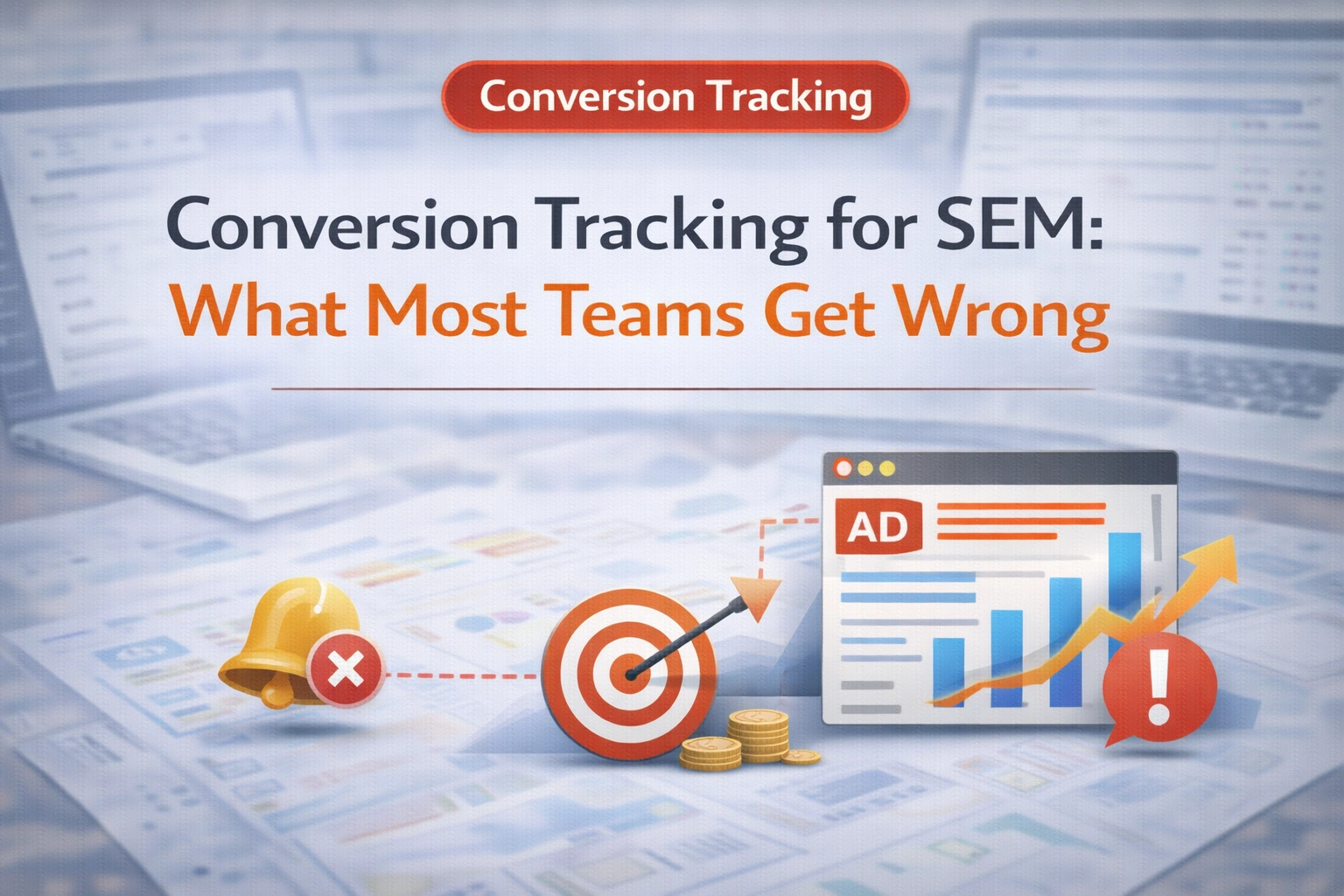
    Conversion Tracking 1024x683
    Share
    Facebook Twitter LinkedIn Pinterest Email

    Introduction

    Most SEM campaigns don’t fail because ads or bids are wrong—they fail because conversion tracking lies. Not intentionally, but structurally. Teams track what’s easy rather than what’s meaningful, then ask automation to optimize based on incomplete or misleading signals. The result is predictable: more “conversions,” worse business outcomes, and rising costs that no amount of optimization seems to fix.

    This article explains what most teams get wrong with conversion tracking in SEM, why tracking errors silently sabotage performance, and how mature teams design conversion frameworks that align paid search optimization with real business value.

    The Hard Truth: SEM Optimizes Exactly What You Tell It To

    SEM platforms do not understand:

    • Lead quality
    • Revenue potential
    • Sales outcomes
    • Business context

    They understand signals.

    If you tell the platform:

    “This button click is a success.”

    …it will aggressively find more of those clicks—regardless of whether they lead to revenue.

    Conversion tracking is not a measurement.
    It’s an instruction.

    The Most Common Conversion Tracking Mistake: Counting Activity as Value

    Many accounts track:

    • Form submissions
    • Button clicks
    • PDF downloads
    • Thank-you page views

    These are actions, not outcomes.

    Why does this break SEM?

    When all conversions are treated equally:

    • Low-quality leads are optimized
    • Automation chases volume
    • CPCs increase
    • Lead quality declines
    • Sales teams lose trust in SEM

    This failure compounds as spending increases.

    Step 1: Define What a “Good Conversion” Actually Is

    Before setting up tracking, you must answer:

    • What action creates business value?
    • Which conversions deserve more spend?
    • Which actions are signals—not goals?

    Conversion hierarchy example

    Action Type
    Qualified sales call Primary
    Demo request Primary
    General contact form Secondary
    Ebook download Micro-conversion
    Page view Behavioral signal

    SEM should optimize toward primary conversions, not convenience.

    Step 2: Separate Micro-Conversions From Optimization Goals

    Micro-conversions are useful—but dangerous when misused.

    What micro-conversions are good for

    • Diagnosing funnel friction
    • Measuring engagement
    • Understanding user behavior

    What they should NOT be used for

    • Primary bidding optimization
    • Budget decisions
    • Performance evaluation

    Common mistake

    Optimizing campaigns toward:

    “Form submission (any type)”

    This flattens value and confuses algorithms.

    Step 3: Track Lead Quality, Not Just Lead Volume

    A high conversion rate means nothing if leads don’t close.

    Why lead quality matters

    SEM platforms assume:

    All conversions are equal unless told otherwise

    Without quality signals:

    • Automation favors easy conversions
    • Low-intent traffic scales
    • Sales-qualified leads decrease

    Practical solutions

    • Track different conversion actions
    • Assign values by lead type
    • Import offline conversion data
    • Use CRM feedback loops

    Quality must be reflected in the data—manually if necessary.

    Step 4: Use Conversion Values Intentionally (Even If Rough)

    Many teams avoid conversion values because:

    • Revenue attribution is messy
    • Sales cycles are long
    • Values feel “inaccurate.”

    But approximate values are better than equal values.

    Example value model

    Conversion Value
    Sales-qualified lead 100
    Demo request 70
    Contact form 30
    Content download 5

    These values guide automation toward higher-value behavior, even if they’re directional.

    Step 5: Avoid Over-Tracking (More Data ≠ Better Data)

    Tracking too many conversions creates noise.

    Symptoms of over-tracking

    • Conflicting signals
    • Unstable bidding
    • Hard-to-read reports
    • Poor optimization decisions

    Best practice

    • Track a few, meaningful primary conversions
    • Use secondary metrics for diagnostics
    • Review the conversion list quarterly

    Clarity beats completeness.

    Step 6: Validate Conversion Tracking Regularly

    Conversion tracking breaks silently.

    Common causes:

    • Site changes
    • CMS updates
    • Form modifications
    • Tag misfires
    • Consent changes

    What mature teams do

    • Validate tracking monthly
    • Test conversions manually
    • Compare SEM data with analytics and CRM
    • Monitor sudden conversion spikes or drops

    Trust but verify—always.

    Step 7: Align Conversion Tracking With Campaign Intent

    Not all campaigns should optimize toward the same conversion.

    Intent-based conversion alignment

    Campaign Type Optimization Goal
    Brand Qualified lead
    High intent non-brand Sales action
    Mid intent Assisted conversion
    Low intent Engagement or micro

    Forcing low-intent campaigns to convert immediately increases CPA and degrades learning.

    Step 8: Beware of “Smart” Tracking Defaults

    Platforms encourage:

    • Auto-created conversions
    • Default “all conversions” optimization
    • Broad attribution windows

    Why is this risky

    • Irrelevant actions become optimization goals
    • Noise overwhelms the signal
    • Performance looks better—but isn’t

    Mature SEM teams manually curate:

    • What counts as a conversion
    • What is used for bidding
    • What is reported vs optimized

    Defaults favor platforms—not advertisers.

    Step 9: Understand Attribution Limitations (and Accept Them)

    No attribution model is perfect.

    Problems include:

    • Cross-device behavior
    • Long sales cycles
    • Offline influence
    • Multi-touch journeys

    What matters

    Not perfect attribution—but consistent directional accuracy.

    Chasing perfect attribution often delays execution and masks obvious inefficiencies.

    Real-World Pattern: Fixing SEM Without Changing Ads or Bids

    Before

    • High conversion volume
    • Poor lead quality
    • Rising CPA
    • Sales dissatisfaction

    Changes made

    • Removed low-value conversions from optimization
    • Added conversion values
    • Imported qualified lead signals
    • Aligned conversions by intent

    After (60–90 days)

    • Lower conversion volume
    • Higher close rate
    • Improved ROI
    • Stable automation behavior

    Fewer conversions.
    Better business results.

    How Conversion Tracking Impacts Automation Directly

    Automation relies on:

    • Clear success signals
    • Consistent feedback
    • Meaningful outcomes

    Bad tracking:

    • Teaching algorithms the wrong lesson
    • Scales inefficiency
    • Makes optimization unpredictable

    Good tracking:

    • Improves learning
    • Stabilizes bids
    • Enables safe scaling

    Automation is only as smart as the data it receives.

    Common Conversion Tracking Anti-Patterns

    • Optimizing for every form
    • Treating downloads as leads
    • Ignoring CRM feedback
    • Never revisit the conversion setup
    • Letting defaults decide strategy

    These errors compound silently over time.

    Final Takeaway

    SEM does not fail because conversion tracking is missing.
    It fails because conversion tracking is misleading.

    When tracking:

    • Reflects real value
    • Differentiates lead quality
    • Aligns with intent
    • Is governed intentionally

    Paid search becomes efficient, scalable, and trusted by the business.

    Conversion tracking isn’t reporting.
    It’s the steering wheel of SEM.

    Share. Facebook Twitter Pinterest LinkedIn Tumblr Email
    yashwant160@gmail.com
    • Website

    Leave A Reply Cancel Reply

    Don't Miss

    Personal Branding Without the Cringe: Building Professional Credibility That Actually Works

    yashwant160@gmail.comFebruary 6, 2026

    Personal branding has a reputation problem. Too often, it’s confused with self-promotion, performative posting, or…

    Career Resilience: How to Build a Job That Survives Layoffs, AI, and Market Shifts

    February 6, 2026

    From Individual Contributor to Leader: The Career Shift Most People Get Wrong

    February 6, 2026

    The Non-Linear Career: Why the Best Careers No Longer Follow a Straight Path

    February 6, 2026
    Stay In Touch
    • Facebook
    • Twitter
    • Pinterest
    • Instagram
    • YouTube
    • Vimeo

    Subscribe to Updates

    Get the latest creative news from SmartMag about art & design.

    About Us

    Results-driven digital professional with 15+ years of experience across Web Operations, Enterprise SEO, and large-scale digital platforms. I specialize in building, scaling, and optimizing complex websites where performance, search visibility, and operational reliability must work together—not in silos. My work sits at the intersection of strategy and execution, translating business goals into systems that teams can actually run.

    Facebook X (Twitter) Pinterest YouTube
    Our Picks

    Personal Branding Without the Cringe: Building Professional Credibility That Actually Works

    February 6, 2026

    Career Resilience: How to Build a Job That Survives Layoffs, AI, and Market Shifts

    February 6, 2026

    From Individual Contributor to Leader: The Career Shift Most People Get Wrong

    February 6, 2026
    Most Popular

    Top 15 popular link building methods you should consider before it’s too late

    March 24, 20180 Views

    Quality Score Demystified: What Actually Improves SEM Performance

    January 31, 20260 Views

    How SEO, SEM, Email, and Paid Social Should Work Together

    February 2, 20260 Views
    © 2026 All rights reserved. Y. K. Thakur.
    • Home
    • Technical SEO
    • World
    • Lifestyle
    • Buy Now

    Type above and press Enter to search. Press Esc to cancel.