Close Menu
blog.ykthakur.com

    Subscribe to Updates

    Get the latest creative news from FooBar about art, design and business.

    What's Hot

    Personal Branding Without the Cringe: Building Professional Credibility That Actually Works

    February 6, 2026

    Career Resilience: How to Build a Job That Survives Layoffs, AI, and Market Shifts

    February 6, 2026

    From Individual Contributor to Leader: The Career Shift Most People Get Wrong

    February 6, 2026
    Facebook X (Twitter) Instagram
    blog.ykthakur.com
    • Home
    • About Me
    • Case Studies
    • Services
    • Contact Us
    Facebook X (Twitter) Instagram
    Subscribe
    • Blog
    • Search & Growth
      1. SEO
      2. Technical SEO
      3. SEM
      4. Paid Advertisements
      5. View All

      Why SEO Fails Even With the Right Tools and Data

      January 31, 2026

      How to Refresh Old Content Without Losing Rankings

      January 31, 2026

      How to Build a Topic Authority Map for SEO

      January 31, 2026

      E-E-A-T Signals Explained: What Actually Influences Trust and Rankings

      January 31, 2026

      XML Sitemaps at Scale: Signaling Priority, Not Forcing Indexation

      February 3, 2026

      Robots.txt at Scale: Control, Risk, and the Limits of Crawl Directives

      February 3, 2026

      Monitoring, Alerting, and SEO Observability: Seeing Failures Before Traffic Drops

      February 3, 2026

      Migrations, Releases, and SEO Risk: How Technical Changes Break Search at Scale

      February 3, 2026

      Scaling SEM Without Burning Budget

      January 31, 2026

      SEM vs SEO: How Paid Search Should Support Organic Growth

      January 31, 2026

      Quality Score Demystified: What Actually Improves SEM Performance

      January 31, 2026

      Brand vs Non-Brand Search: Budget Allocation Reality

      January 31, 2026

      Personal Branding Without the Cringe: Building Professional Credibility That Actually Works

      February 6, 2026

      Career Resilience: How to Build a Job That Survives Layoffs, AI, and Market Shifts

      February 6, 2026

      From Individual Contributor to Leader: The Career Shift Most People Get Wrong

      February 6, 2026

      The Non-Linear Career: Why the Best Careers No Longer Follow a Straight Path

      February 6, 2026
    • Performance & Infrastructure
      1. Website Performance
      2. Core Web Vitals
      3. Hosting Architecture
      4. Web Application Infrastructure
      5. Load Balancing
      6. View All

      Performance Drift: How Sites Get Slower Without Any One Bad Change

      February 3, 2026

      Why passing scores still hide systemic performance risk

      February 3, 2026

      Performance Monitoring Beyond Core Web Vitals

      February 3, 2026

      Personal Branding Without the Cringe: Building Professional Credibility That Actually Works

      February 6, 2026

      Career Resilience: How to Build a Job That Survives Layoffs, AI, and Market Shifts

      February 6, 2026

      From Individual Contributor to Leader: The Career Shift Most People Get Wrong

      February 6, 2026

      The Non-Linear Career: Why the Best Careers No Longer Follow a Straight Path

      February 6, 2026
    • AI & Automation
      1. AI Content Systems
      2. AI in SEO & Marketing
      3. AI Search Analysis
      4. AI-Driven SEO Workflows
      5. Generative AI Strategy
      6. View All

      AI Content Systems: How to Scale Without Losing Quality or Trust

      February 3, 2026

      AI in Marketing Is a System, Not a Toolset

      February 3, 2026

      SEO in a Zero-Click World: Designing for AI Answers and Visibility

      February 3, 2026

      AI Search Analysis: How LLMs Interpret and Surface Content

      February 3, 2026

      Using AI for Technical SEO Analysis Without Breaking Trust

      February 3, 2026

      AI-Driven SEO Workflows: What to Automate and What Not To

      February 3, 2026

      SEO in a Zero-Click World: Designing for AI Answers and Visibility

      February 3, 2026

      AI Search Analysis: How LLMs Interpret and Surface Content

      February 3, 2026

      Using AI for Technical SEO Analysis Without Breaking Trust

      February 3, 2026

      AI-Driven SEO Workflows: What to Automate and What Not To

      February 3, 2026

      Why Most AI SEO Implementations Fail

      February 3, 2026

      Human-in-the-Loop SEO: Where AI Stops and Judgment Starts

      February 3, 2026

      Personal Branding Without the Cringe: Building Professional Credibility That Actually Works

      February 6, 2026

      Career Resilience: How to Build a Job That Survives Layoffs, AI, and Market Shifts

      February 6, 2026

      From Individual Contributor to Leader: The Career Shift Most People Get Wrong

      February 6, 2026

      The Non-Linear Career: Why the Best Careers No Longer Follow a Straight Path

      February 6, 2026
    • Analytics & Intelligence
      1. GA4 Architecture
      2. Adobe Analytics
      3. View All

      GA4 vs Adobe Analytics: Choosing the Right Tool for Your Organization

      February 2, 2026

      Consent, Privacy, and Measurement: What Changes After GDPR & GA4

      February 2, 2026

      GA4 Architecture Explained: Designing Events for Real Decisions

      February 2, 2026

      GA4 vs Adobe Analytics: Choosing the Right Tool for Your Organization

      February 2, 2026

      Personal Branding Without the Cringe: Building Professional Credibility That Actually Works

      February 6, 2026

      Career Resilience: How to Build a Job That Survives Layoffs, AI, and Market Shifts

      February 6, 2026

      From Individual Contributor to Leader: The Career Shift Most People Get Wrong

      February 6, 2026

      The Non-Linear Career: Why the Best Careers No Longer Follow a Straight Path

      February 6, 2026
    • WebOps & DevOps
      1. Web Operations
      2. WebOps Roles
      3. Website Migrations & Scaling
      4. Release Management
      5. Monitoring & Alerts
      6. Performance Monitoring
      7. Deployment Automation
      8. View All

      SEO and WebOps Monitoring: Aligning Health Signals Across Systems

      February 3, 2026

      Designing Alerts for WebOps: Signal, Severity, and Actionability

      February 3, 2026

      Why Most Website Monitoring Is Too Late to Be Useful

      February 3, 2026

      Release Cadence Versus Stability: Finding the Sustainable Balance

      February 3, 2026

      Website Migrations at Scale: Why Most Fail Before the First Redirect

      February 3, 2026

      Post-Migration Reality: Why SEO and Performance Losses Persist for Months

      February 3, 2026

      Scaling Websites Without Replatforming: When Migration Is the Wrong Answer

      February 3, 2026

      Release Cadence Versus Stability: Finding the Sustainable Balance

      February 3, 2026

      Why Website Releases Break SEO Even When Nothing “Major” Changes

      February 3, 2026

      Release Management for Websites: Coordinating Risk Across Teams

      February 3, 2026

      Release Pipelines and Search Risk: Why Velocity Without Guardrails Breaks Websites

      February 3, 2026

      SEO and WebOps Monitoring: Aligning Health Signals Across Systems

      February 3, 2026

      Designing Alerts for WebOps: Signal, Severity, and Actionability

      February 3, 2026

      Why Most Website Monitoring Is Too Late to Be Useful

      February 3, 2026

      Feature Flags, Experiments, and the SEO Blast Radius

      February 3, 2026

      Performance Drift: How Sites Get Slower Without Any One Bad Change

      February 3, 2026

      Performance Monitoring Beyond Core Web Vitals

      February 3, 2026

      Designing SEO-Safe Deployment Automation

      February 3, 2026

      Deployment Automation for Websites: What to Automate and What Not To

      February 3, 2026

      Personal Branding Without the Cringe: Building Professional Credibility That Actually Works

      February 6, 2026

      Career Resilience: How to Build a Job That Survives Layoffs, AI, and Market Shifts

      February 6, 2026

      From Individual Contributor to Leader: The Career Shift Most People Get Wrong

      February 6, 2026

      The Non-Linear Career: Why the Best Careers No Longer Follow a Straight Path

      February 6, 2026
    • Project Strategy

      Personal Branding Without the Cringe: Building Professional Credibility That Actually Works

      February 6, 2026

      Career Resilience: How to Build a Job That Survives Layoffs, AI, and Market Shifts

      February 6, 2026

      From Individual Contributor to Leader: The Career Shift Most People Get Wrong

      February 6, 2026

      The Non-Linear Career: Why the Best Careers No Longer Follow a Straight Path

      February 6, 2026

      How to Stay Relevant When Roles Are Changing Faster Than Job Descriptions

      February 6, 2026
    • Web Engineering
      1. Web Development
      2. Web Designing & UX
      3. CMS & Platforms
      4. Web Application Firewall
      5. View All

      Personal Branding Without the Cringe: Building Professional Credibility That Actually Works

      February 6, 2026

      Career Resilience: How to Build a Job That Survives Layoffs, AI, and Market Shifts

      February 6, 2026

      From Individual Contributor to Leader: The Career Shift Most People Get Wrong

      February 6, 2026

      The Non-Linear Career: Why the Best Careers No Longer Follow a Straight Path

      February 6, 2026
    blog.ykthakur.com
    Home»SEM»Ad Copy Optimization»Ad Copy Optimization: Writing Ads That Match Search Intent
    Ad Copy Optimization

    Ad Copy Optimization: Writing Ads That Match Search Intent

    yashwant160@gmail.comBy yashwant160@gmail.comJanuary 31, 2026Updated:February 1, 2026No Comments5 Mins Read
    Share Facebook Twitter Pinterest LinkedIn Tumblr Email
    Follow Us
    Google News Flipboard Threads
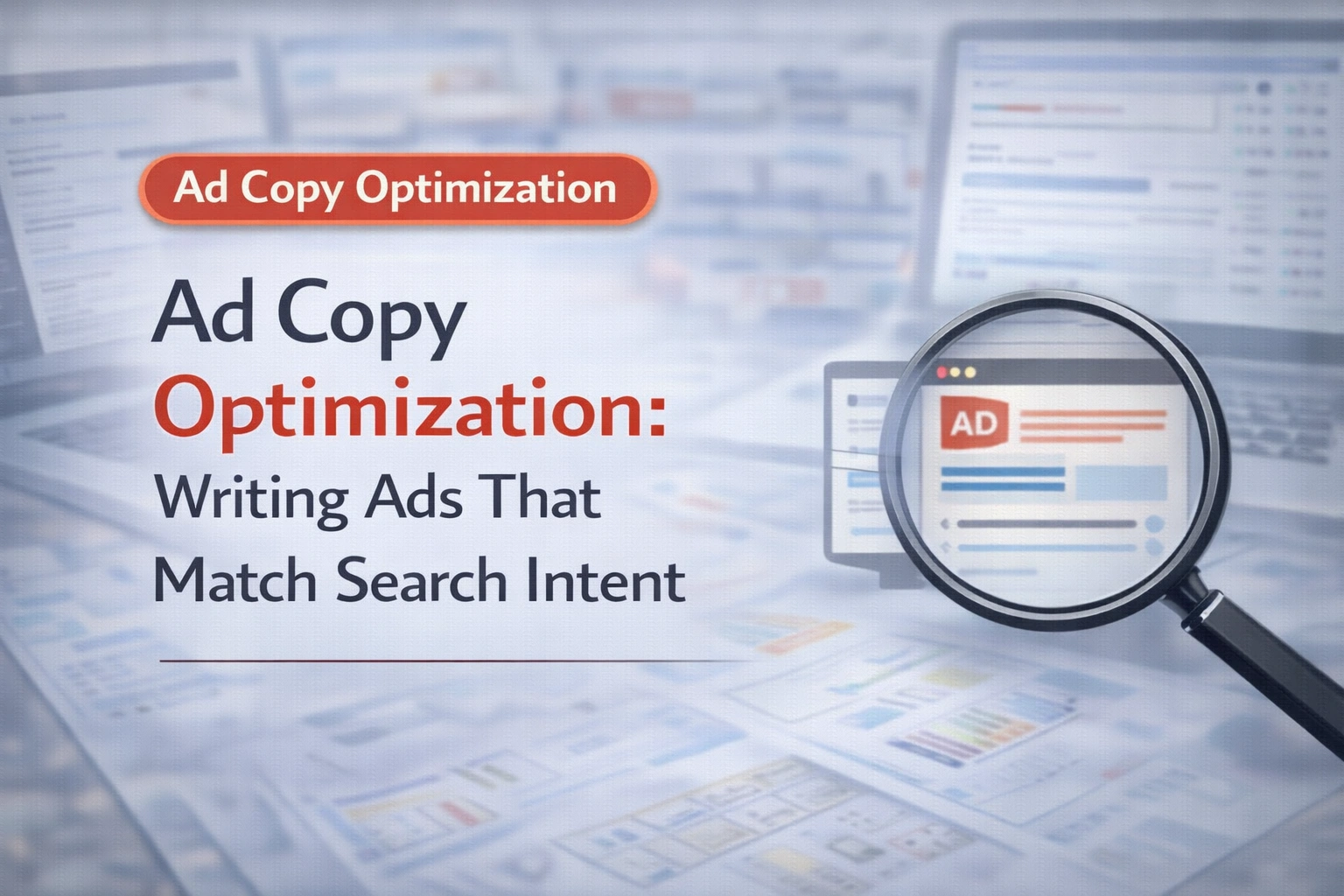
    Ad Copy0optemization 1024x683
    Share
    Facebook Twitter LinkedIn Pinterest Email

    Introduction

    Most SEM ads fail for a simple reason: they talk about the advertiser, not the searcher. Even with strong keywords, clean structure, and healthy budgets, ads underperform when they don’t align with why someone searched in the first place. In modern SEM, ad copy is not just a hook—it’s a filter. Well-written ads repel the wrong clicks and attract the right ones. Poorly written ads do the opposite, inflating costs and degrading performance.

    This article explains how to optimize ad copy by matching search intent, why intent alignment improves both performance and efficiency, and how mature SEM teams write ads that convert before the click.

    Why Ad Copy Matters More Than Ever

    Ad platforms evaluate ads on more than CTR alone. Ad copy influences:

    • Click-through rate (CTR)
    • Quality Score
    • CPC efficiency
    • Conversion quality
    • Downstream landing page performance

    When ad copy is aligned with intent:

    • CTR increases naturally
    • CPC decreases over time
    • Conversion rates stabilize
    • Lead quality improves

    When it isn’t, no amount of bidding can compensate.

    The Biggest Ad Copy Mistake: Writing for Everyone

    Many ads are written to be:

    • Broad
    • Safe
    • Brand-focused
    • Feature-heavy

    Typical weak ad example

    “Full-Service Digital Marketing Agency
    SEO, SEM, Social & More
    Get a Free Consultation Today”

    This ad is technically fine—but functionally vague.
    It doesn’t answer why the user searched.

    Broad ads:

    • Attract unqualified clicks
    • Suppress Quality Score
    • Increase wasted spend

    Intent Comes Before Creativity

    Ad copy optimization is not about clever writing—it’s about intent clarity.

    Before writing ads, you must answer:

    • What problem triggered this search?
    • How urgent is that problem?
    • What outcome does the user expect?
    • What decision stage are they in?

    Only then should the copy be written.

    The Four Core Search Intent Types (SEM Context)

    1. High Intent (Action-Ready)

    Users are ready to act.

    Examples:

    • “SEO audit services.”
    • “Google Ads consultant pricing.”

    Ad copy should:

    • Reduce risk
    • Clarify value
    • Emphasize outcomes
    1. Comparison Intent

    Users are evaluating options.

    Examples:

    • “SEO vs SEM.”
    • “Best PPC agency.”

    Ad copy should:

    • Position differentiation
    • Acknowledge trade-offs
    • Build credibility
    1. Problem-Aware / Mid Intent

    Users know something is wrong.

    Examples:

    • “Website traffic dropped.”
    • “Ads not converting.”

    Ad copy should:

    • Name the problem
    • Signal expertise
    • Offer guidance
    1. Low Intent / Research

    Users are learning.

    Examples:

    • “What is SEM?”
    • “How Google Ads works.”

    Ad copy should:

    • Educate
    • Set expectations
    • Avoid aggressive selling

    Step 1: Write One Ad Set per Intent (Not per Keyword)

    Keywords express what was typed.
    Intent explains why it was typed.

    Why these matters

    When ads are shared across mixed-intent keywords:

    • Messaging becomes generic
    • CTR drops
    • Quality Score declines
    • Conversion quality suffers

    Best practice

    Group keywords by:

    • Problem type
    • Decision stage
    • Urgency

    Then write ads only for that group.

    Step 2: Lead With the User’s Problem, Not Your Offering

    Users scan ads. The first line must resonate instantly.

    Weak opening lines

    • “Award-Winning Agency.”
    • “Trusted by 1,000+ Brands.”
    • “Expert Digital Marketing Services.”

    These talk about you.

    Strong opening lines

    • “Traffic Dropping Month Over Month?”
    • “High CPCs but Low Conversions?”
    • “Google Ads Spending More Than It Should?”

    These talk about them.

    Problem-first copy:

    • Improves relevance
    • Pre-qualifies clicks
    • Increases downstream conversion quality

    Step 3: Match Ad Promises to Landing Page Reality

    Ad copy creates expectations.
    Landing pages must fulfill them.

    Common failure pattern

    • Ad promises a solution
    • The landing page introduces the company
    • User abandons

    Example mismatch

    Ad:
    “Fix Declining Leads in 30 Days”

    Landing Page:
    “Welcome to Our Agency”

    This gap destroys trust instantly.

    Step 4: Use Specificity to Increase Trust

    Specific ads outperform generic ones.

    Generic copy

    “Improve Your Online Presence”

    Specific copy

    “Recover Lost SEO Traffic After a Site Redesign”

    Specificity signals:

    • Experience
    • Relevance
    • Credibility

    It also filters out users who are not a fit—saving budget.

    Step 5: Treat Headlines as Filters, Not Magnets

    CTR alone is not a success.

    High CTR + low conversion = failure.

    Well-optimized ads:

    • Sometimes lower CTR
    • Often improve CPA
    • Almost always improves lead quality

    Example

    Approach CTR CPA Lead Quality
    Broad messaging High High Low
    Problem-specific Medium Lower High

    Filtering clicks is a feature—not a flaw.

    Step 6: Use Ad Extensions to Reinforce Intent

    Ad extensions should:

    • Support the core message
    • Add clarity, not clutter

    Effective extensions include:

    • Structured snippets (services, use cases)
    • Callouts (risk reducers, timelines)
    • Sitelinks (intent-matched pages)

    Avoid:

    • Repeating the same message
    • Adding irrelevant sitelinks
    • Overloading ads with noise

    Step 7: Test Messaging, Not Just Variations

    Many teams test:

    • Word order
    • Capitalization
    • CTA phrasing

    High-performing team’s test:

    • Problem framing
    • Outcome promises
    • Risk reducers
    • Qualification language

    Example test axis

    • “Free Audit” vs “Audit for Sites Losing Traffic.”
    • “Contact Us” vs “See Why Rankings Dropped.”

    Test meaning, not cosmetics.

    Common Ad Copy Mistakes That Inflate Spend

    • Writing brand-first copy
    • Reusing ads across intents
    • Promising what landing pages don’t deliver
    • Chasing CTR without measuring quality
    • Using buzzwords instead of clarity

    These mistakes compound as budgets grow.

    How Ad Copy Influences Quality Score (Indirectly)

    While Quality Score is opaque, ad copy affects:

    • Expected CTR
    • Relevance
    • Landing page alignment

    Better copy:

    • Improves relevance signals
    • Reduces CPC pressure
    • Stabilizes performance over time

    Real-World Pattern: Ad Copy Fix Without Budget Increase

    Before

    • High CTR
    • Low conversion rate
    • Rising CPCs

    Changes made

    • Rewrote ads around specific problems
    • Reduced broad appeal
    • Matched ads to intent-specific landing pages

    After (6–8 weeks)

    • CTR slightly lower
    • CPA is significantly lower
    • Lead quality improved
    • Spend efficiency increased

    Better ads didn’t attract more clicks—just better ones.

    How AI and Automation React to Better Ad Copy

    Automation performs best when:

    • Ads signal clear intent
    • Clicks convert consistently
    • Noise is reduced

    Good ad copy:

    • Improves algorithm learning
    • Speeds optimization cycles
    • Reduces volatility

    Automation doesn’t replace copy—it depends on it.

    Final Takeaway

    Ad copy optimization is not about clever language—it’s about intent alignment.

    When ads:

    • Speak to real problems
    • Match search intent
    • Set accurate expectations
    • Filter unqualified clicks

    SEM becomes more efficient, more predictable, and easier to scale.

    Ads don’t convince users to convert. They decide who should click.

    Share. Facebook Twitter Pinterest LinkedIn Tumblr Email
    yashwant160@gmail.com
    • Website

    Related Posts

    Quality Score Demystified: What Actually Improves SEM Performance

    January 31, 2026
    Leave A Reply Cancel Reply

    Don't Miss

    Personal Branding Without the Cringe: Building Professional Credibility That Actually Works

    yashwant160@gmail.comFebruary 6, 2026

    Personal branding has a reputation problem. Too often, it’s confused with self-promotion, performative posting, or…

    Career Resilience: How to Build a Job That Survives Layoffs, AI, and Market Shifts

    February 6, 2026

    From Individual Contributor to Leader: The Career Shift Most People Get Wrong

    February 6, 2026

    The Non-Linear Career: Why the Best Careers No Longer Follow a Straight Path

    February 6, 2026
    Stay In Touch
    • Facebook
    • Twitter
    • Pinterest
    • Instagram
    • YouTube
    • Vimeo

    Subscribe to Updates

    Get the latest creative news from SmartMag about art & design.

    About Us

    Results-driven digital professional with 15+ years of experience across Web Operations, Enterprise SEO, and large-scale digital platforms. I specialize in building, scaling, and optimizing complex websites where performance, search visibility, and operational reliability must work together—not in silos. My work sits at the intersection of strategy and execution, translating business goals into systems that teams can actually run.

    Facebook X (Twitter) Pinterest YouTube
    Our Picks

    Personal Branding Without the Cringe: Building Professional Credibility That Actually Works

    February 6, 2026

    Career Resilience: How to Build a Job That Survives Layoffs, AI, and Market Shifts

    February 6, 2026

    From Individual Contributor to Leader: The Career Shift Most People Get Wrong

    February 6, 2026
    Most Popular

    Top 15 popular link building methods you should consider before it’s too late

    March 24, 20180 Views

    Quality Score Demystified: What Actually Improves SEM Performance

    January 31, 20260 Views

    How SEO, SEM, Email, and Paid Social Should Work Together

    February 2, 20260 Views
    © 2026 All rights reserved. Y. K. Thakur.
    • Home
    • Technical SEO
    • World
    • Lifestyle
    • Buy Now

    Type above and press Enter to search. Press Esc to cancel.