Close Menu
blog.ykthakur.com

    Subscribe to Updates

    Get the latest creative news from FooBar about art, design and business.

    What's Hot

    Personal Branding Without the Cringe: Building Professional Credibility That Actually Works

    February 6, 2026

    Career Resilience: How to Build a Job That Survives Layoffs, AI, and Market Shifts

    February 6, 2026

    From Individual Contributor to Leader: The Career Shift Most People Get Wrong

    February 6, 2026
    Facebook X (Twitter) Instagram
    blog.ykthakur.com
    • Home
    • About Me
    • Case Studies
    • Services
    • Contact Us
    Facebook X (Twitter) Instagram
    Subscribe
    • Blog
    • Search & Growth
      1. SEO
      2. Technical SEO
      3. SEM
      4. Paid Advertisements
      5. View All

      Why SEO Fails Even With the Right Tools and Data

      January 31, 2026

      How to Refresh Old Content Without Losing Rankings

      January 31, 2026

      How to Build a Topic Authority Map for SEO

      January 31, 2026

      E-E-A-T Signals Explained: What Actually Influences Trust and Rankings

      January 31, 2026

      XML Sitemaps at Scale: Signaling Priority, Not Forcing Indexation

      February 3, 2026

      Robots.txt at Scale: Control, Risk, and the Limits of Crawl Directives

      February 3, 2026

      Monitoring, Alerting, and SEO Observability: Seeing Failures Before Traffic Drops

      February 3, 2026

      Migrations, Releases, and SEO Risk: How Technical Changes Break Search at Scale

      February 3, 2026

      Scaling SEM Without Burning Budget

      January 31, 2026

      SEM vs SEO: How Paid Search Should Support Organic Growth

      January 31, 2026

      Quality Score Demystified: What Actually Improves SEM Performance

      January 31, 2026

      Brand vs Non-Brand Search: Budget Allocation Reality

      January 31, 2026

      Personal Branding Without the Cringe: Building Professional Credibility That Actually Works

      February 6, 2026

      Career Resilience: How to Build a Job That Survives Layoffs, AI, and Market Shifts

      February 6, 2026

      From Individual Contributor to Leader: The Career Shift Most People Get Wrong

      February 6, 2026

      The Non-Linear Career: Why the Best Careers No Longer Follow a Straight Path

      February 6, 2026
    • Performance & Infrastructure
      1. Website Performance
      2. Core Web Vitals
      3. Hosting Architecture
      4. Web Application Infrastructure
      5. Load Balancing
      6. View All

      Performance Drift: How Sites Get Slower Without Any One Bad Change

      February 3, 2026

      Why passing scores still hide systemic performance risk

      February 3, 2026

      Performance Monitoring Beyond Core Web Vitals

      February 3, 2026

      Personal Branding Without the Cringe: Building Professional Credibility That Actually Works

      February 6, 2026

      Career Resilience: How to Build a Job That Survives Layoffs, AI, and Market Shifts

      February 6, 2026

      From Individual Contributor to Leader: The Career Shift Most People Get Wrong

      February 6, 2026

      The Non-Linear Career: Why the Best Careers No Longer Follow a Straight Path

      February 6, 2026
    • AI & Automation
      1. AI Content Systems
      2. AI in SEO & Marketing
      3. AI Search Analysis
      4. AI-Driven SEO Workflows
      5. Generative AI Strategy
      6. View All

      AI Content Systems: How to Scale Without Losing Quality or Trust

      February 3, 2026

      AI in Marketing Is a System, Not a Toolset

      February 3, 2026

      SEO in a Zero-Click World: Designing for AI Answers and Visibility

      February 3, 2026

      AI Search Analysis: How LLMs Interpret and Surface Content

      February 3, 2026

      Using AI for Technical SEO Analysis Without Breaking Trust

      February 3, 2026

      AI-Driven SEO Workflows: What to Automate and What Not To

      February 3, 2026

      SEO in a Zero-Click World: Designing for AI Answers and Visibility

      February 3, 2026

      AI Search Analysis: How LLMs Interpret and Surface Content

      February 3, 2026

      Using AI for Technical SEO Analysis Without Breaking Trust

      February 3, 2026

      AI-Driven SEO Workflows: What to Automate and What Not To

      February 3, 2026

      Why Most AI SEO Implementations Fail

      February 3, 2026

      Human-in-the-Loop SEO: Where AI Stops and Judgment Starts

      February 3, 2026

      Personal Branding Without the Cringe: Building Professional Credibility That Actually Works

      February 6, 2026

      Career Resilience: How to Build a Job That Survives Layoffs, AI, and Market Shifts

      February 6, 2026

      From Individual Contributor to Leader: The Career Shift Most People Get Wrong

      February 6, 2026

      The Non-Linear Career: Why the Best Careers No Longer Follow a Straight Path

      February 6, 2026
    • Analytics & Intelligence
      1. GA4 Architecture
      2. Adobe Analytics
      3. View All

      GA4 vs Adobe Analytics: Choosing the Right Tool for Your Organization

      February 2, 2026

      Consent, Privacy, and Measurement: What Changes After GDPR & GA4

      February 2, 2026

      GA4 Architecture Explained: Designing Events for Real Decisions

      February 2, 2026

      GA4 vs Adobe Analytics: Choosing the Right Tool for Your Organization

      February 2, 2026

      Personal Branding Without the Cringe: Building Professional Credibility That Actually Works

      February 6, 2026

      Career Resilience: How to Build a Job That Survives Layoffs, AI, and Market Shifts

      February 6, 2026

      From Individual Contributor to Leader: The Career Shift Most People Get Wrong

      February 6, 2026

      The Non-Linear Career: Why the Best Careers No Longer Follow a Straight Path

      February 6, 2026
    • WebOps & DevOps
      1. Web Operations
      2. WebOps Roles
      3. Website Migrations & Scaling
      4. Release Management
      5. Monitoring & Alerts
      6. Performance Monitoring
      7. Deployment Automation
      8. View All

      SEO and WebOps Monitoring: Aligning Health Signals Across Systems

      February 3, 2026

      Designing Alerts for WebOps: Signal, Severity, and Actionability

      February 3, 2026

      Why Most Website Monitoring Is Too Late to Be Useful

      February 3, 2026

      Release Cadence Versus Stability: Finding the Sustainable Balance

      February 3, 2026

      Website Migrations at Scale: Why Most Fail Before the First Redirect

      February 3, 2026

      Post-Migration Reality: Why SEO and Performance Losses Persist for Months

      February 3, 2026

      Scaling Websites Without Replatforming: When Migration Is the Wrong Answer

      February 3, 2026

      Release Cadence Versus Stability: Finding the Sustainable Balance

      February 3, 2026

      Why Website Releases Break SEO Even When Nothing “Major” Changes

      February 3, 2026

      Release Management for Websites: Coordinating Risk Across Teams

      February 3, 2026

      Release Pipelines and Search Risk: Why Velocity Without Guardrails Breaks Websites

      February 3, 2026

      SEO and WebOps Monitoring: Aligning Health Signals Across Systems

      February 3, 2026

      Designing Alerts for WebOps: Signal, Severity, and Actionability

      February 3, 2026

      Why Most Website Monitoring Is Too Late to Be Useful

      February 3, 2026

      Feature Flags, Experiments, and the SEO Blast Radius

      February 3, 2026

      Performance Drift: How Sites Get Slower Without Any One Bad Change

      February 3, 2026

      Performance Monitoring Beyond Core Web Vitals

      February 3, 2026

      Designing SEO-Safe Deployment Automation

      February 3, 2026

      Deployment Automation for Websites: What to Automate and What Not To

      February 3, 2026

      Personal Branding Without the Cringe: Building Professional Credibility That Actually Works

      February 6, 2026

      Career Resilience: How to Build a Job That Survives Layoffs, AI, and Market Shifts

      February 6, 2026

      From Individual Contributor to Leader: The Career Shift Most People Get Wrong

      February 6, 2026

      The Non-Linear Career: Why the Best Careers No Longer Follow a Straight Path

      February 6, 2026
    • Project Strategy

      Personal Branding Without the Cringe: Building Professional Credibility That Actually Works

      February 6, 2026

      Career Resilience: How to Build a Job That Survives Layoffs, AI, and Market Shifts

      February 6, 2026

      From Individual Contributor to Leader: The Career Shift Most People Get Wrong

      February 6, 2026

      The Non-Linear Career: Why the Best Careers No Longer Follow a Straight Path

      February 6, 2026

      How to Stay Relevant When Roles Are Changing Faster Than Job Descriptions

      February 6, 2026
    • Web Engineering
      1. Web Development
      2. Web Designing & UX
      3. CMS & Platforms
      4. Web Application Firewall
      5. View All

      Personal Branding Without the Cringe: Building Professional Credibility That Actually Works

      February 6, 2026

      Career Resilience: How to Build a Job That Survives Layoffs, AI, and Market Shifts

      February 6, 2026

      From Individual Contributor to Leader: The Career Shift Most People Get Wrong

      February 6, 2026

      The Non-Linear Career: Why the Best Careers No Longer Follow a Straight Path

      February 6, 2026
    blog.ykthakur.com
    Home»SEO»Content SEO»How to Refresh Old Content Without Losing Rankings
    Content SEO

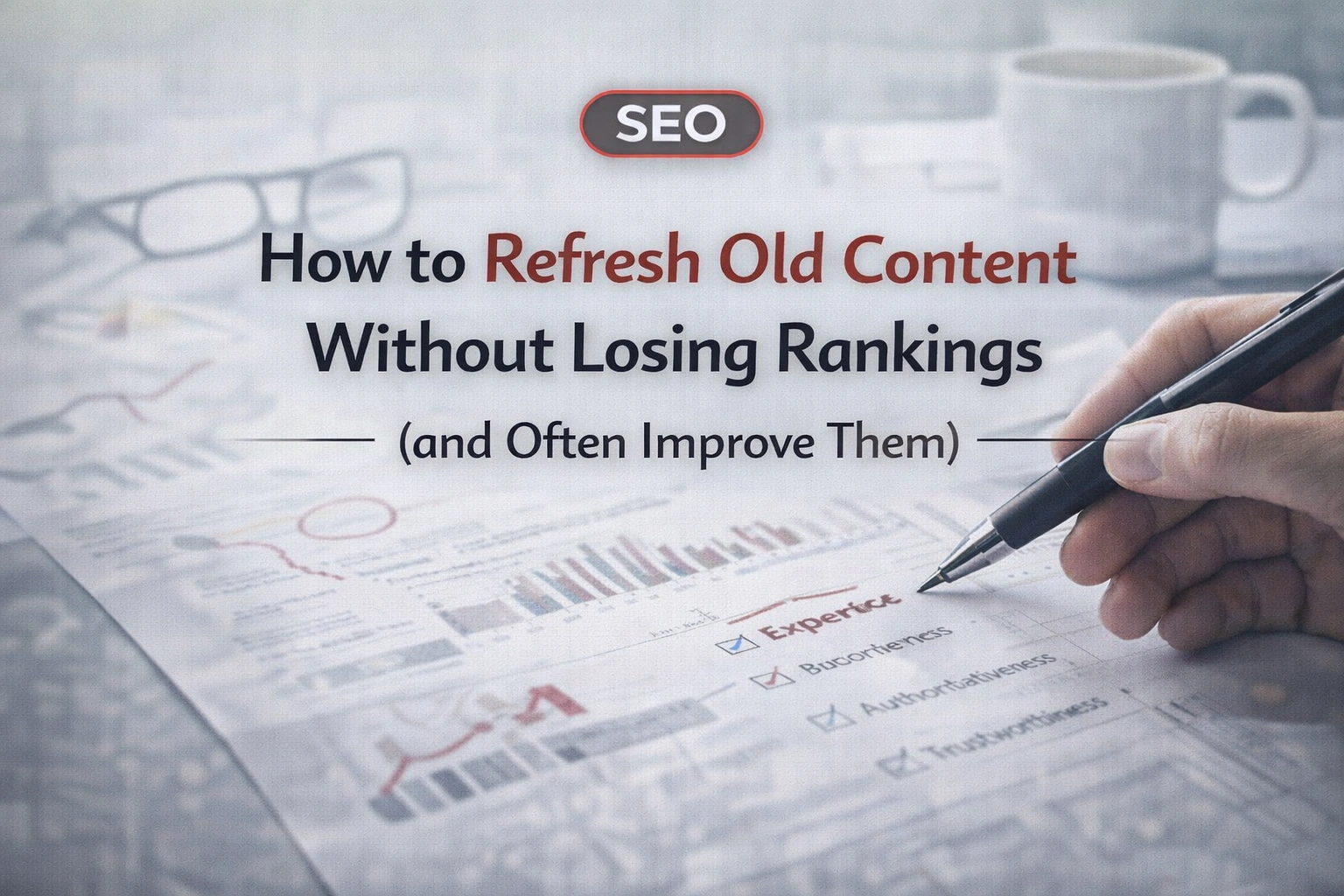
    How to Refresh Old Content Without Losing Rankings

    yashwant160@gmail.comBy yashwant160@gmail.comJanuary 31, 2026Updated:January 31, 2026No Comments5 Mins Read
    Share Facebook Twitter Pinterest LinkedIn Tumblr Email
    Follow Us
    Google News Flipboard Threads
    Refresh Old Content 1024x683
    Share
    Facebook Twitter LinkedIn Pinterest Email

    Introduction

    Content decay is one of the most common—and least addressed—causes of SEO stagnation. Pages that once ranked well gradually lose visibility as search intent shifts, competitors update their content, and AI-driven search favors fresher, clearer sources. Yet many teams avoid updating content out of fear they’ll break what’s already working. In reality, controlled content refreshes are one of the safest and highest-ROI SEO activities available when done correctly.

    This article explains how to refresh old content without losing rankings, what metrics actually improve after a refresh, and how experienced SEO teams use updates to regain visibility, engagement, and trust.

    Why Old Content Loses Rankings (Even If It Was “Evergreen”)

    Content rarely fails suddenly. It decays quietly.

    Common causes include:

    • Search intent evolution
    • New SERP formats (AI summaries, featured snippets)
    • Competitor expansion
    • Outdated examples or references
    • Structural drift caused by incremental edits

    Key insight

    Search engines don’t penalize old content—but they reward relevance, clarity, and freshness.

    If competitors improve faster than you do, rankings slip by comparison.

    What “Refreshing Content” Actually Means (And What It Doesn’t)

    A content refresh is not:

    • Rewriting the article from scratch
    • Changing the URL
    • Chasing new keywords
    • Adding random sections for SEO

    A proper refresh is:

    • Intent-preserving
    • Structure-improving
    • Signal-strengthening

    Metrics That Typically Improve After a Proper Refresh

    Based on repeated refresh cycles across mature sites, the following metrics most commonly improve within 30–90 days:

    Metric Typical Improvement Range
    Average position +3 to +12 positions
    Click-through rate (CTR) +10% to +35%
    Impressions +15% to +60%
    Engagement time +20% to +45%
    Assisted conversions +5% to +25%

    The biggest gains usually come from CTR and impressions, not immediate top-3 jumps.

    The Safe Content Refresh Framework (Used by Mature SEO Teams)

    Step 1: Preserve the URL and Primary Intent

    The fastest way to lose rankings is to:

    • Change the URL
    • Shift the page’s core intent

    Before touching the content, confirm:

    • The primary keyword still matches intent
    • The page serves the same audience
    • The page still deserves to exist

    If intent has changed completely, create a new page instead.

    Step 2: Revalidate Search Intent Using Live SERPs

    Search intent evolves.

    Before updating:

    • Review the top 10 ranking pages
    • Identify changes in format (lists, comparisons, summaries)
    • Note AI Overviews or featured snippets

    Example

    If your page is a long narrative guide, but:

    • Top results now use tables and frameworks
    • AI summaries favor definitions and steps

    You must adjust the structure, not just the wording.

    Step 3: Improve Structural Clarity First (Before Adding Words)

    The biggest gains usually come from restructuring, not expanding.

    High-impact structural improvements:

    • Clear H2/H3 hierarchy
    • Stronger introduction that defines the scope
    • Removal of redundant sections
    • Improved section sequencing

    Why this works

    AI systems and users both reward predictable, scannable structure.

    Step 4: Update Examples, Not Just Explanations

    Outdated examples are one of the fastest trust killers.

    Replace:

    • Old tools
    • Deprecated tactics
    • Historical screenshots
    • Outdated metrics

    With:

    • Current workflows
    • Modern constraints
    • Recent outcomes
    • Real-world scenarios

    Example

    Instead of: “Page speed tools like PageSpeed Insights…”

    Use: “In real-world audits, we often see LCP improvements stall because CLS issues introduced by third-party scripts negate perceived gains—especially on mobile.”

    This signals experience, not theory.

    Step 5: Strengthen Internal Linking (Often the Biggest Win)

    Content refresh is the best moment to:

    • Add links to newer cluster articles
    • Reinforce links back to pillar pages
    • Update anchor text for clarity

    Internal linking improvements often lead to:

    • Faster reindexing
    • Better authority flow
    • Improved ranking stability

    In many cases, no new backlinks are needed.

    Step 6: Refresh Metadata for CTR Gains

    Meta titles and descriptions decay, too.

    After refreshes:

    • CTR improvements of 15–30% are common
    • Especially on pages ranking positions 4–10

    Focus on:

    • Clear problem framing
    • Outcome-driven language
    • Removing generic phrasing

    Real-World Refresh Example (Sanitized)

    Before refresh

    • Position: 11–14
    • CTR: ~1.8%
    • Engagement time: ~1:40

    Changes made

    • Reworked introduction
    • Updated examples
    • Added internal links to newer articles
    • Improved headings
    • Updated meta title and description

    After 60 days

    • Position: 5–7
    • CTR: ~3.1%
    • Engagement time: ~2:30
    • Assisted conversions increased by ~18%

    No URL change. No backlink campaign.
    Just structural and relevance improvements.

    What NOT to Change During a Refresh (High-Risk Moves)

    Avoid:

    • Changing the primary keyword focus
    • Removing ranking sections without replacements
    • Over-optimizing anchors
    • Adding FAQs that compete with pillar pages
    • Publishing massive updates without monitoring

    Refreshes should feel incremental, not disruptive.

    How Often Should It Be Refreshed

    A practical cadence:

    Content Type Review Frequency
    Pillar pages Every 6 months
    High-traffic articles Every 6–9 months
    Supporting clusters Annually
    Low-performing content Evaluate for consolidation

    Content maintenance is cheaper than content creation.

    Refreshing Content for AI Visibility

    AI-powered search favors:

    • Clear definitions
    • Updated framing
    • Consistent terminology
    • Reduced ambiguity

    Refreshing content improves:

    • AI summarization accuracy
    • Citation likelihood
    • Inclusion in answer-style results

    This is increasingly visible in AI Overviews.

    Common Reasons Refreshes Fail

    • Intent not revalidated
    • Too many changes at once
    • Content expanded without clarity
    • Internal links ignored
    • No post-update monitoring

    Refreshes require discipline, not creativity.

    How to Measure Refresh Success Properly

    Avoid judging success solely by:

    • Immediate ranking jumps

    Track instead:

    • Impression growth
    • CTR improvements
    • Engagement depth
    • Assisted conversion paths

    These stabilize before rankings peak.

    Final Takeaway

    Refreshing content is not a risk—it’s maintenance.

    When done correctly, content refreshes:

    • Preserve rankings
    • Improve visibility
    • Increase engagement
    • Strengthen trust signals
    • Support AI-driven search inclusion

    In mature SEO programs, refreshes often outperform new content in ROI.

    Share. Facebook Twitter Pinterest LinkedIn Tumblr Email
    yashwant160@gmail.com
    • Website

    Related Posts

    How to Build a Topic Authority Map for SEO

    January 31, 2026

    Search Intent Mapping: Aligning Content With User and AI Expectations

    January 31, 2026
    Leave A Reply Cancel Reply

    Don't Miss

    Personal Branding Without the Cringe: Building Professional Credibility That Actually Works

    yashwant160@gmail.comFebruary 6, 2026

    Personal branding has a reputation problem. Too often, it’s confused with self-promotion, performative posting, or…

    Career Resilience: How to Build a Job That Survives Layoffs, AI, and Market Shifts

    February 6, 2026

    From Individual Contributor to Leader: The Career Shift Most People Get Wrong

    February 6, 2026

    The Non-Linear Career: Why the Best Careers No Longer Follow a Straight Path

    February 6, 2026
    Stay In Touch
    • Facebook
    • Twitter
    • Pinterest
    • Instagram
    • YouTube
    • Vimeo

    Subscribe to Updates

    Get the latest creative news from SmartMag about art & design.

    About Us

    Results-driven digital professional with 15+ years of experience across Web Operations, Enterprise SEO, and large-scale digital platforms. I specialize in building, scaling, and optimizing complex websites where performance, search visibility, and operational reliability must work together—not in silos. My work sits at the intersection of strategy and execution, translating business goals into systems that teams can actually run.

    Facebook X (Twitter) Pinterest YouTube
    Our Picks

    Personal Branding Without the Cringe: Building Professional Credibility That Actually Works

    February 6, 2026

    Career Resilience: How to Build a Job That Survives Layoffs, AI, and Market Shifts

    February 6, 2026

    From Individual Contributor to Leader: The Career Shift Most People Get Wrong

    February 6, 2026
    Most Popular

    Top 15 popular link building methods you should consider before it’s too late

    March 24, 20180 Views

    Quality Score Demystified: What Actually Improves SEM Performance

    January 31, 20260 Views

    How SEO, SEM, Email, and Paid Social Should Work Together

    February 2, 20260 Views
    © 2026 All rights reserved. Y. K. Thakur.
    • Home
    • Technical SEO
    • World
    • Lifestyle
    • Buy Now

    Type above and press Enter to search. Press Esc to cancel.