Close Menu
blog.ykthakur.com

    Subscribe to Updates

    Get the latest creative news from FooBar about art, design and business.

    What's Hot

    Personal Branding Without the Cringe: Building Professional Credibility That Actually Works

    February 6, 2026

    Career Resilience: How to Build a Job That Survives Layoffs, AI, and Market Shifts

    February 6, 2026

    From Individual Contributor to Leader: The Career Shift Most People Get Wrong

    February 6, 2026
    Facebook X (Twitter) Instagram
    blog.ykthakur.com
    • Home
    • About Me
    • Case Studies
    • Services
    • Contact Us
    Facebook X (Twitter) Instagram
    Subscribe
    • Blog
    • Search & Growth
      1. SEO
      2. Technical SEO
      3. SEM
      4. Paid Advertisements
      5. View All

      Why SEO Fails Even With the Right Tools and Data

      January 31, 2026

      How to Refresh Old Content Without Losing Rankings

      January 31, 2026

      How to Build a Topic Authority Map for SEO

      January 31, 2026

      E-E-A-T Signals Explained: What Actually Influences Trust and Rankings

      January 31, 2026

      XML Sitemaps at Scale: Signaling Priority, Not Forcing Indexation

      February 3, 2026

      Robots.txt at Scale: Control, Risk, and the Limits of Crawl Directives

      February 3, 2026

      Monitoring, Alerting, and SEO Observability: Seeing Failures Before Traffic Drops

      February 3, 2026

      Migrations, Releases, and SEO Risk: How Technical Changes Break Search at Scale

      February 3, 2026

      Scaling SEM Without Burning Budget

      January 31, 2026

      SEM vs SEO: How Paid Search Should Support Organic Growth

      January 31, 2026

      Quality Score Demystified: What Actually Improves SEM Performance

      January 31, 2026

      Brand vs Non-Brand Search: Budget Allocation Reality

      January 31, 2026

      Personal Branding Without the Cringe: Building Professional Credibility That Actually Works

      February 6, 2026

      Career Resilience: How to Build a Job That Survives Layoffs, AI, and Market Shifts

      February 6, 2026

      From Individual Contributor to Leader: The Career Shift Most People Get Wrong

      February 6, 2026

      The Non-Linear Career: Why the Best Careers No Longer Follow a Straight Path

      February 6, 2026
    • Performance & Infrastructure
      1. Website Performance
      2. Core Web Vitals
      3. Hosting Architecture
      4. Web Application Infrastructure
      5. Load Balancing
      6. View All

      Performance Drift: How Sites Get Slower Without Any One Bad Change

      February 3, 2026

      Why passing scores still hide systemic performance risk

      February 3, 2026

      Performance Monitoring Beyond Core Web Vitals

      February 3, 2026

      Personal Branding Without the Cringe: Building Professional Credibility That Actually Works

      February 6, 2026

      Career Resilience: How to Build a Job That Survives Layoffs, AI, and Market Shifts

      February 6, 2026

      From Individual Contributor to Leader: The Career Shift Most People Get Wrong

      February 6, 2026

      The Non-Linear Career: Why the Best Careers No Longer Follow a Straight Path

      February 6, 2026
    • AI & Automation
      1. AI Content Systems
      2. AI in SEO & Marketing
      3. AI Search Analysis
      4. AI-Driven SEO Workflows
      5. Generative AI Strategy
      6. View All

      AI Content Systems: How to Scale Without Losing Quality or Trust

      February 3, 2026

      AI in Marketing Is a System, Not a Toolset

      February 3, 2026

      SEO in a Zero-Click World: Designing for AI Answers and Visibility

      February 3, 2026

      AI Search Analysis: How LLMs Interpret and Surface Content

      February 3, 2026

      Using AI for Technical SEO Analysis Without Breaking Trust

      February 3, 2026

      AI-Driven SEO Workflows: What to Automate and What Not To

      February 3, 2026

      SEO in a Zero-Click World: Designing for AI Answers and Visibility

      February 3, 2026

      AI Search Analysis: How LLMs Interpret and Surface Content

      February 3, 2026

      Using AI for Technical SEO Analysis Without Breaking Trust

      February 3, 2026

      AI-Driven SEO Workflows: What to Automate and What Not To

      February 3, 2026

      Why Most AI SEO Implementations Fail

      February 3, 2026

      Human-in-the-Loop SEO: Where AI Stops and Judgment Starts

      February 3, 2026

      Personal Branding Without the Cringe: Building Professional Credibility That Actually Works

      February 6, 2026

      Career Resilience: How to Build a Job That Survives Layoffs, AI, and Market Shifts

      February 6, 2026

      From Individual Contributor to Leader: The Career Shift Most People Get Wrong

      February 6, 2026

      The Non-Linear Career: Why the Best Careers No Longer Follow a Straight Path

      February 6, 2026
    • Analytics & Intelligence
      1. GA4 Architecture
      2. Adobe Analytics
      3. View All

      GA4 vs Adobe Analytics: Choosing the Right Tool for Your Organization

      February 2, 2026

      Consent, Privacy, and Measurement: What Changes After GDPR & GA4

      February 2, 2026

      GA4 Architecture Explained: Designing Events for Real Decisions

      February 2, 2026

      GA4 vs Adobe Analytics: Choosing the Right Tool for Your Organization

      February 2, 2026

      Personal Branding Without the Cringe: Building Professional Credibility That Actually Works

      February 6, 2026

      Career Resilience: How to Build a Job That Survives Layoffs, AI, and Market Shifts

      February 6, 2026

      From Individual Contributor to Leader: The Career Shift Most People Get Wrong

      February 6, 2026

      The Non-Linear Career: Why the Best Careers No Longer Follow a Straight Path

      February 6, 2026
    • WebOps & DevOps
      1. Web Operations
      2. WebOps Roles
      3. Website Migrations & Scaling
      4. Release Management
      5. Monitoring & Alerts
      6. Performance Monitoring
      7. Deployment Automation
      8. View All

      SEO and WebOps Monitoring: Aligning Health Signals Across Systems

      February 3, 2026

      Designing Alerts for WebOps: Signal, Severity, and Actionability

      February 3, 2026

      Why Most Website Monitoring Is Too Late to Be Useful

      February 3, 2026

      Release Cadence Versus Stability: Finding the Sustainable Balance

      February 3, 2026

      Website Migrations at Scale: Why Most Fail Before the First Redirect

      February 3, 2026

      Post-Migration Reality: Why SEO and Performance Losses Persist for Months

      February 3, 2026

      Scaling Websites Without Replatforming: When Migration Is the Wrong Answer

      February 3, 2026

      Release Cadence Versus Stability: Finding the Sustainable Balance

      February 3, 2026

      Why Website Releases Break SEO Even When Nothing “Major” Changes

      February 3, 2026

      Release Management for Websites: Coordinating Risk Across Teams

      February 3, 2026

      Release Pipelines and Search Risk: Why Velocity Without Guardrails Breaks Websites

      February 3, 2026

      SEO and WebOps Monitoring: Aligning Health Signals Across Systems

      February 3, 2026

      Designing Alerts for WebOps: Signal, Severity, and Actionability

      February 3, 2026

      Why Most Website Monitoring Is Too Late to Be Useful

      February 3, 2026

      Feature Flags, Experiments, and the SEO Blast Radius

      February 3, 2026

      Performance Drift: How Sites Get Slower Without Any One Bad Change

      February 3, 2026

      Performance Monitoring Beyond Core Web Vitals

      February 3, 2026

      Designing SEO-Safe Deployment Automation

      February 3, 2026

      Deployment Automation for Websites: What to Automate and What Not To

      February 3, 2026

      Personal Branding Without the Cringe: Building Professional Credibility That Actually Works

      February 6, 2026

      Career Resilience: How to Build a Job That Survives Layoffs, AI, and Market Shifts

      February 6, 2026

      From Individual Contributor to Leader: The Career Shift Most People Get Wrong

      February 6, 2026

      The Non-Linear Career: Why the Best Careers No Longer Follow a Straight Path

      February 6, 2026
    • Project Strategy

      Personal Branding Without the Cringe: Building Professional Credibility That Actually Works

      February 6, 2026

      Career Resilience: How to Build a Job That Survives Layoffs, AI, and Market Shifts

      February 6, 2026

      From Individual Contributor to Leader: The Career Shift Most People Get Wrong

      February 6, 2026

      The Non-Linear Career: Why the Best Careers No Longer Follow a Straight Path

      February 6, 2026

      How to Stay Relevant When Roles Are Changing Faster Than Job Descriptions

      February 6, 2026
    • Web Engineering
      1. Web Development
      2. Web Designing & UX
      3. CMS & Platforms
      4. Web Application Firewall
      5. View All

      Personal Branding Without the Cringe: Building Professional Credibility That Actually Works

      February 6, 2026

      Career Resilience: How to Build a Job That Survives Layoffs, AI, and Market Shifts

      February 6, 2026

      From Individual Contributor to Leader: The Career Shift Most People Get Wrong

      February 6, 2026

      The Non-Linear Career: Why the Best Careers No Longer Follow a Straight Path

      February 6, 2026
    blog.ykthakur.com
    Home»SEO»Content SEO»Search Intent Mapping: Aligning Content With User and AI Expectations
    Content SEO

    Search Intent Mapping: Aligning Content With User and AI Expectations

    yashwant160@gmail.comBy yashwant160@gmail.comJanuary 31, 2026Updated:January 31, 2026No Comments5 Mins Read
    Share Facebook Twitter Pinterest LinkedIn Tumblr Email
    Follow Us
    Google News Flipboard Threads
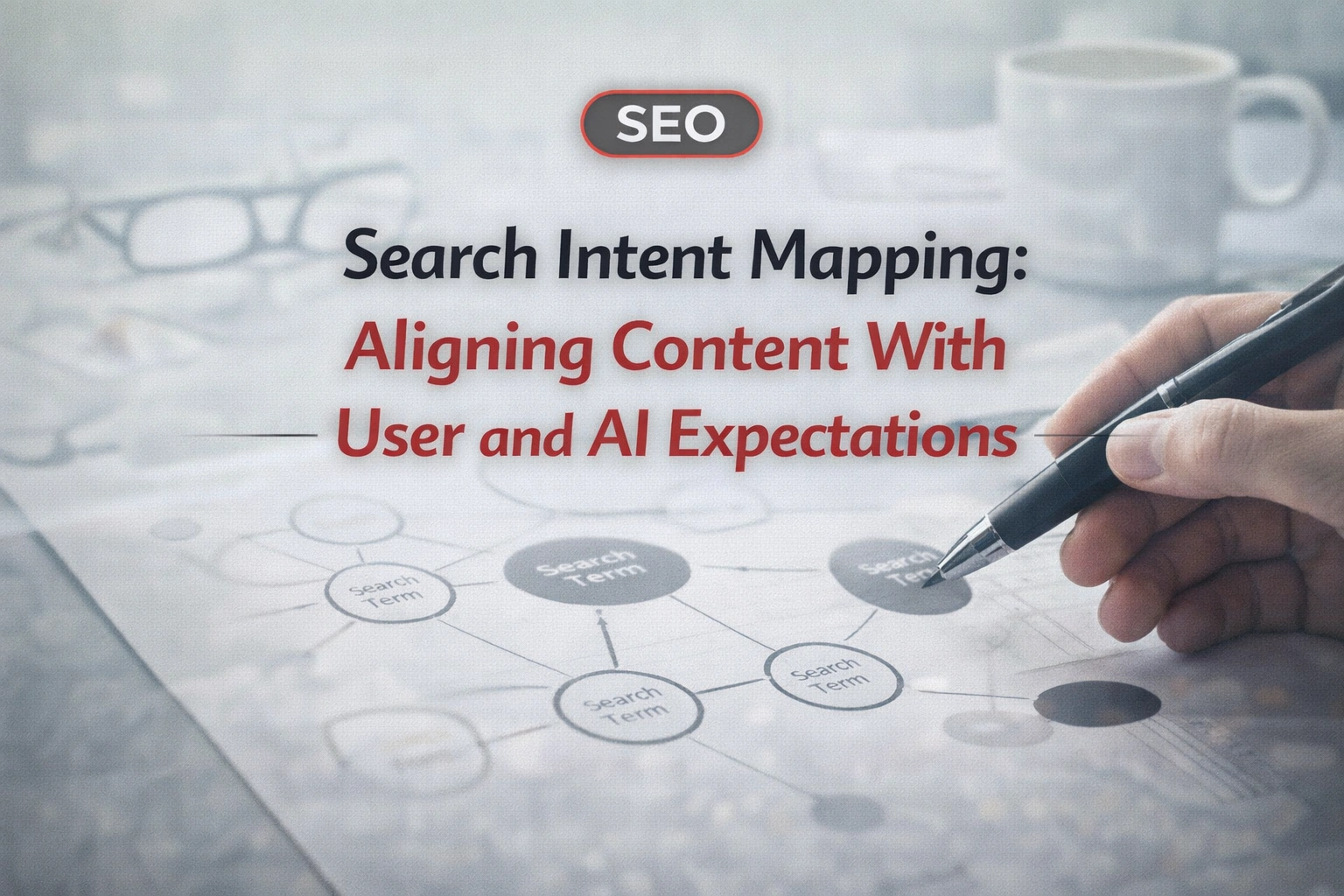
    Search Intent Explaination 1024x683
    Share
    Facebook Twitter LinkedIn Pinterest Email

    Introduction

    Many SEO campaigns fail before they even begin because the content answers the wrong question. Search engines today don’t rank pages simply because they’re well written or technically sound—they rank pages that match intent precisely. In 2026, intent mismatch is one of the fastest ways to waste content investment. If your page format, depth, or angle doesn’t align with what users and AI systems expect for a query, rankings stall—even if everything else is done correctly.

    This article explains how search intent actually works today, how AI has tightened intent expectations, and how to map content correctly so it satisfies users, search engines, and AI-driven answers at the same time.

    What Search Intent Really Means (Beyond the Basics)

    At a surface level, search intent is usually described as:

    • Informational
    • Commercial
    • Transactional
    • Navigational

    That framework is still useful—but it’s no longer sufficient.

    Modern search systems interpret intent across multiple layers, not just category.

    Modern intent includes:

    • User goal (what they’re trying to achieve)
    • Decision stage (learning, comparing, deciding)
    • Expected format (guide, list, tool, comparison)
    • Depth tolerance (quick answer vs deep explanation)
    • Risk level (how costly a wrong answer would be)

    If your content misses even one of these layers, relevance weakens.

    Why Intent Alignment Matters More Than Ever

    Search engines now filter results before ranking them.

    If your content doesn’t match intent:

    • It’s deprioritized
    • It may rank briefly, then drop
    • It may never surface at all

    AI-powered search systems amplify this behavior by:

    • Summarizing answers across sources
    • Favoring clarity over creativity
    • Selecting content that fits a predictable answer structure

    This makes intent accuracy non-negotiable.

    How AI Changed Search Intent Expectations

    AI-driven search experiences (AI Overviews, conversational search, assistants) have raised the bar.

    AI prefers content that:

    • Clearly defines the topic
    • Answers the question directly
    • Matches the dominant format
    • Avoids unnecessary digressions

    AI struggles with:

    • Mixed intent pages
    • Sales-heavy educational content
    • Overly verbose answers to simple questions
    • Vague positioning

    Practical implication

    If your content is trying to educate and sell and compare and persuade—all at once—it often satisfies none of those intents well.

    The Most Common Intent Mapping Mistake

    The most common failure pattern looks like this:

    A team identifies a high-volume keyword and writes “the best possible article” without validating intent.

    This leads to:

    • Guides ranking for buyer keywords
    • Sales pages targeting informational queries
    • Long-form articles competing with lists or tools

    Example: “SEO audit”

    This single keyword hides multiple intents.

    Query Variation Dominant Intent Expected Content
    What is an SEO audit? Informational Definition + explanation
    SEO audit checklist Procedural Step-by-step list
    SEO audit tools Commercial Tool comparison
    SEO audit services Transactional Service page

    Trying to satisfy all of these with one page guarantees underperformance.

    A Practical Search Intent Mapping Framework

    Before creating or evaluating content, map intent using this framework.

    Step 1: Identify the Primary User Goal

    Ask:

    • What problem is the user trying to solve right now?
    • What would success look like for them?

    Step 2: Determine the Decision Stage

    Is the user:

    • Learning?
    • Comparing options?
    • Ready to act?

    Step 3: Analyze SERP Patterns

    Look at:

    • Page types ranking
    • Content length
    • Use of lists, tables, and tools
    • Presence of brands or services

    Search engines already reveal intent through results.

    Step 4: Define the Expected Format

    Is the dominant format:

    • Guide?
    • Checklist?
    • Comparison?
    • Calculator?
    • Definition?

    Format mismatch is one of the fastest ranking killers.

    Real Example: Intent Mismatch in Practice

    Scenario

    A SaaS company targets the keyword “internal linking strategy.”

    They publish:

    • A long sales-led article
    • Heavy product promotion
    • Minimal tactical explanation

    What the SERP shows

    • Educational guides
    • Diagrams
    • Step-by-step frameworks
    • No product-first pages

    Result

    • Initial indexing
    • No sustained ranking
    • Low engagement
    • High bounce rate

    Fix

    • Reframe as an educational guide
    • Move product mentions to contextual examples
    • Align depth and format with SERP expectations

    Rankings improve without changing the keyword.

    Intent Mapping for AI-First Search

    AI systems favor content that:

    • The state’s intent is clear early
    • Uses predictable structure
    • Answers the primary question directly
    • Expands only after clarity is established

    This is why optimized introductions matter.

    Your first paragraph should:

    • Define the problem
    • Clarify the angle
    • Signal who the content is for

    If AI can’t classify your page quickly, it won’t surface it confidently.

    Intent Drift: The Silent SEO Killer

    Intent drift happens when:

    • Content is updated without reevaluating intent
    • New sections are added for “SEO value.”
    • Pages try to capture adjacent queries

    Over time, the page becomes unfocused.

    Signs of intent drift

    • Rankings fluctuate without a clear cause
    • Page ranks for many queries, but converts poorly
    • AI summaries skip your content

     How to Prevent Intent Drift

    Use these guardrails:

    • One primary intent per page
    • Secondary intents must support—not compete
    • Revalidate intent during every major update
    • Avoid adding sections “just for keywords.”

    Intent discipline protects long-term performance.

    Informational vs Commercial Intent (Critical Distinction)

    Many teams blur this line—and pay for it.

    Informational content should:

    • Teach
    • Explain
    • Clarify
    • Build trust

    Commercial content should:

    • Compare options
    • Explain value
    • Reduce risk
    • Drive decisions

    Trying to convert too early damages credibility.

    Intent Mapping vs Keyword Research

    Keyword research tells you what people search.
    Intent mapping tells you how to answer correctly.

    Comparison

    Keyword Research Intent Mapping
    Volume-focused Outcome-focused
    Query-based User-goal-based
    Static Contextual
    Tool-driven SERP-driven

    Both are required—but intent mapping comes first.

    How Enterprise Teams Handle Intent at Scale

    Enterprise SEO teams:

    • Classify intent during planning
    • Separate educational and commercial URLs
    • Enforce format standards
    • Review intent alignment during refresh cycles

    This is why their content ages better.

    Final Takeaway

    Search intent is no longer a checkbox—it’s the entry requirement for visibility.

    If your content doesn’t:

    • Match user goals
    • Match SERP patterns
    • Match AI expectations

    …it won’t sustain rankings.

    When intent is mapped correctly, optimization becomes easier, rankings stabilize, and content performs longer.

    Share. Facebook Twitter Pinterest LinkedIn Tumblr Email
    yashwant160@gmail.com
    • Website

    Related Posts

    How to Refresh Old Content Without Losing Rankings

    January 31, 2026

    How to Build a Topic Authority Map for SEO

    January 31, 2026
    Leave A Reply Cancel Reply

    Don't Miss

    Personal Branding Without the Cringe: Building Professional Credibility That Actually Works

    yashwant160@gmail.comFebruary 6, 2026

    Personal branding has a reputation problem. Too often, it’s confused with self-promotion, performative posting, or…

    Career Resilience: How to Build a Job That Survives Layoffs, AI, and Market Shifts

    February 6, 2026

    From Individual Contributor to Leader: The Career Shift Most People Get Wrong

    February 6, 2026

    The Non-Linear Career: Why the Best Careers No Longer Follow a Straight Path

    February 6, 2026
    Stay In Touch
    • Facebook
    • Twitter
    • Pinterest
    • Instagram
    • YouTube
    • Vimeo

    Subscribe to Updates

    Get the latest creative news from SmartMag about art & design.

    About Us

    Results-driven digital professional with 15+ years of experience across Web Operations, Enterprise SEO, and large-scale digital platforms. I specialize in building, scaling, and optimizing complex websites where performance, search visibility, and operational reliability must work together—not in silos. My work sits at the intersection of strategy and execution, translating business goals into systems that teams can actually run.

    Facebook X (Twitter) Pinterest YouTube
    Our Picks

    Personal Branding Without the Cringe: Building Professional Credibility That Actually Works

    February 6, 2026

    Career Resilience: How to Build a Job That Survives Layoffs, AI, and Market Shifts

    February 6, 2026

    From Individual Contributor to Leader: The Career Shift Most People Get Wrong

    February 6, 2026
    Most Popular

    Top 15 popular link building methods you should consider before it’s too late

    March 24, 20180 Views

    Quality Score Demystified: What Actually Improves SEM Performance

    January 31, 20260 Views

    How SEO, SEM, Email, and Paid Social Should Work Together

    February 2, 20260 Views
    © 2026 All rights reserved. Y. K. Thakur.
    • Home
    • Technical SEO
    • World
    • Lifestyle
    • Buy Now

    Type above and press Enter to search. Press Esc to cancel.